
Increasing distributed generation hosting capacity in distributionsystems via optimal coordination of electric vehicle aggregators
ISSN:
1751-8695 (online)1751-8687 (print)
DOI:
10.1049/gtd2.12026Date:
2021-01Abstract:
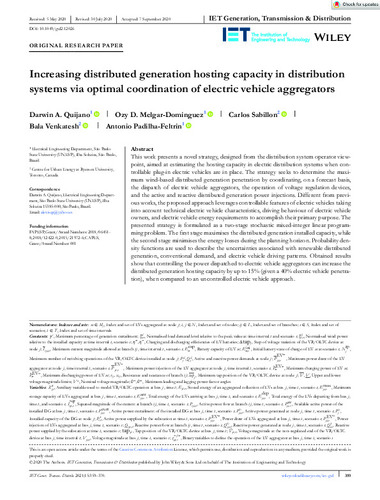
This work presents a novel strategy, designed from the distribution system operator view-point, aimed at estimating the hosting capacity in electric distribution systems when con-trollable plug-in electric vehicles are in place. The strategy seeks to determine the maxi-mum wind-based distributed generation penetration by coordinating, on a forecast basis,the dispatch of electric vehicle aggregators, the operation of voltage regulation devices,and the active and reactive distributed generation power injections. Different from previ-ous works, the proposed approach leverages controllable features of electric vehicles takinginto account technical electric vehicle characteristics, driving behaviour of electric vehicleowners, and electric vehicle energy requirements to accomplish their primary purpose. Thepresented strategy is formulated as a two-stage stochastic mixed-integer linear program-ming problem. The first stage maximises the distributed generation installed capacity, whilethe second stage minimises the energy losses during the planning horizon. Probability den-sity functions are used to describe the uncertainties associated with renewable distributedgeneration, conventional demand, and electric vehicle driving patterns. Obtained resultsshow that controlling the power dispatched to electric vehicle aggregators can increase thedistributed generation hosting capacity by up to 15% (given a 40% electric vehicle penetra-tion), when compared to an uncontrolled electric vehicle approach
Collections
Files in this item
Share

Statistics
