Brújula Home

Institutional repository of the Universidad Loyola

View Item 
  •   Brújula Home
  • PRODUCCIÓN CIENTÍFICA Y TRANSFERENCIA
  • Departamento Ingeniería
  • Artículos
  • View Item
  •   Brújula Home
  • PRODUCCIÓN CIENTÍFICA Y TRANSFERENCIA
  • Departamento Ingeniería
  • Artículos
  • View Item
    • español
    • English
JavaScript is disabled for your browser. Some features of this site may not work without it.

Browse

All of BrújulaCommunities and CollectionsAuthorsTitlesKeywordsAuthor profilesThis CollectionAuthorsTitlesKeywords

My Account

Login

Statistics

View Usage Statistics

Añadido Recientemente

Novedades
Repository
How to publish
Visibility
FAQs

Role of Particle Size on the Cohesive Behavior of Limestone Powders at High Temperature

Author:
Durán-Olivencia, F. J.; Espín, M. J.; Valverde, José Manuel
URI:
https://hdl.handle.net/20.500.12412/5034
ISSN:
1873-3212
DOI:
10.1016/j.cej.2019.123520
Date:
2020-07-01
Keyword(s):

Calcium Looping (CaL)

Concentrated Solar Power (CSP)

Thermochemical Energy Storage (TCES)

Thermal Energy Storage (TES)

Cohesive Granular Media

Fluidization

Granular Materials

Abstract:

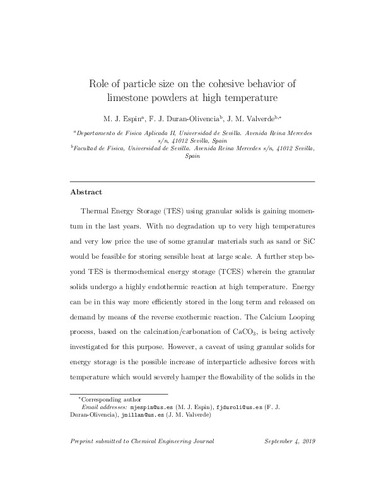
Thermal Energy Storage (TES) using granular solids is gaining momentum in the last years. With no degradation up to very high temperatures and very low price, the use of some granular materials such as sand or SiC would be feasible for storing sensible heat at large scale. A further step beyond TES is thermochemical energy storage (TCES) wherein the granular solids undergo a highly endothermic reaction at high temperature. Energy can be in this way more efficiently stored in the long term and released on demand by means of the reverse exothermic reaction. The Calcium Looping process, based on the calcination/carbonation of CaCO3, is being actively investigated for this purpose. However, a caveat of using granular solids for energy storage is the possible increase of interparticle adhesive forces with temperature which would severely hamper the flowability of the solids in the process. The cohesiveness of granular materials is essentially determined by particle size. In this paper we investigate the dependence of the tensile yield strength and compressibility of CaCO3 powders on temperature and consoli- dation stress using samples of narrow particle size distribution in the relevant range between ∼30 and ∼80 μm particle size and temperatures up to 500◦C. Our experimental results show that powder cohesiveness is greatly increased with temperature especially in the case of the finest powders whose tensile yield strength can be increased by up 2 orders of magnitude. The increase of cohesiveness with temperature is further enhanced with a previously applied consolidation stress, which is particularly relevant for applications wherein large amounts of solids are to be stored at high temperature. Experimental data are consistent with the predictions by a contact mechanics model assuming that the solids deform plastically at interparticle contacts. A main conclusion from our work is that some mechanical properties of the solids, specially the mechanical hardness, and how they change with temperature, play a critical role on the flowability of the solids as affected by an increase of temperature.

Thermal Energy Storage (TES) using granular solids is gaining momentum in the last years. With no degradation up to very high temperatures and very low price, the use of some granular materials such as sand or SiC would be feasible for storing sensible heat at large scale. A further step beyond TES is thermochemical energy storage (TCES) wherein the granular solids undergo a highly endothermic reaction at high temperature. Energy can be in this way more efficiently stored in the long term and released on demand by means of the reverse exothermic reaction. The Calcium Looping process, based on the calcination/carbonation of CaCO3, is being actively investigated for this purpose. However, a caveat of using granular solids for energy storage is the possible increase of interparticle adhesive forces with temperature which would severely hamper the flowability of the solids in the process. The cohesiveness of granular materials is essentially determined by particle size. In this paper we investigate the dependence of the tensile yield strength and compressibility of CaCO3 powders on temperature and consoli- dation stress using samples of narrow particle size distribution in the relevant range between ∼30 and ∼80 μm particle size and temperatures up to 500◦C. Our experimental results show that powder cohesiveness is greatly increased with temperature especially in the case of the finest powders whose tensile yield strength can be increased by up 2 orders of magnitude. The increase of cohesiveness with temperature is further enhanced with a previously applied consolidation stress, which is particularly relevant for applications wherein large amounts of solids are to be stored at high temperature. Experimental data are consistent with the predictions by a contact mechanics model assuming that the solids deform plastically at interparticle contacts. A main conclusion from our work is that some mechanical properties of the solids, specially the mechanical hardness, and how they change with temperature, play a critical role on the flowability of the solids as affected by an increase of temperature.


Versión aceptada del artículo. La versión final puede consultarse en: https://doi.org/10.1016/j.cej.2019.123520

Versión aceptada del artículo. La versión final puede consultarse en: https://doi.org/10.1016/j.cej.2019.123520

 
Show full item record
Collections
  • Artículos
Files in this item
Thumbnail
main article (accepted version) (3.496Mb)
Share
Export to Mendeley
Statistics
Usage statistics
Metrics and citations  
Go to Brújula home

Universidad Loyola

Library

Contact

Facebook Loyola BibliotecaTwitter Loyola Biblioteca

The content of the Repository is protected with a Creative Commons license:

Attribution-NonCommercial-NoDerivatives 4.0 Internacional

Creative Commons Image