Brújula Home

Institutional repository of the Universidad Loyola

View Item 
  •   Brújula Home
  • PRODUCCIÓN CIENTÍFICA Y TRANSFERENCIA
  • Departamento de Salud
  • Artículos
  • View Item
  •   Brújula Home
  • PRODUCCIÓN CIENTÍFICA Y TRANSFERENCIA
  • Departamento de Salud
  • Artículos
  • View Item
    • español
    • English
JavaScript is disabled for your browser. Some features of this site may not work without it.

Browse

All of BrújulaCommunities and CollectionsAuthorsTitlesKeywordsAuthor profilesThis CollectionAuthorsTitlesKeywords

My Account

Login

Statistics

View Usage Statistics

Añadido Recientemente

Novedades
Repository
How to publish
Visibility
FAQs

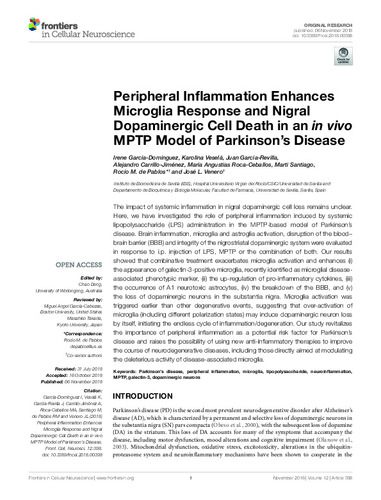
Peripheral Inflammation Enhances Microglia Response and Nigral Dopaminergic Cell Death in an in vivo MPTP Model of Parkinson's Disease.

Author:
García-Domínguez, Irene; Veselà, Karolina; García-Revilla, Juan; Carrillo-Jiménez, Alejandro; Roca-Ceballos, María Angustias; [et al.]
URI:
https://hdl.handle.net/20.500.12412/5055
ISSN:
1662-5102
DOI:
10.3389/fncel.2018.00398
Date:
2018-11-06
Keyword(s):

MPTP; Parkinson’s disease; dopaminergic neurons; galectin-3; lipopolysaccharide; microglia; neuroinflammation; peripheral inflammation.

MPTP

Parkinson’s disease

Dopaminergic neurons

Galectin-3

Lipopolysaccharide

Microglia

Neuroinflammation

Peripheral inflammation

Abstract:

The impact of systemic inflammation in nigral dopaminergic cell loss remains unclear. Here, we have investigated the role of peripheral inflammation induced by systemic lipopolysaccharide (LPS) administration in the MPTP-based model of Parkinson's disease. Brain inflammation, microglia and astroglia activation, disruption of the blood-brain barrier (BBB) and integrity of the nigrostriatal dopaminergic system were evaluated in response to i.p. injection of LPS, MPTP or the combination of both. Our results showed that combinative treatment exacerbates microglia activation and enhances (i) the appearance of galectin-3-positive microglia, recently identified as microglial disease-associated phenotypic marker, (ii) the up-regulation of pro-inflammatory cytokines, (iii) the occurrence of A1 neurotoxic astrocytes, (iv) the breakdown of the BBB, and (v) the loss of dopaminergic neurons in the substantia nigra. Microglia activation was triggered earlier than other degenerative events, suggesting that over-activation of microglia (including different polarization states) may induce dopaminergic neuron loss by itself, initiating the endless cycle of inflammation/degeneration. Our study revitalizes the importance of peripheral inflammation as a potential risk factor for Parkinson's disease and raises the possibility of using new anti-inflammatory therapies to improve the course of neurodegenerative diseases, including those directly aimed at modulating the deleterious activity of disease-associated microglia.

The impact of systemic inflammation in nigral dopaminergic cell loss remains unclear. Here, we have investigated the role of peripheral inflammation induced by systemic lipopolysaccharide (LPS) administration in the MPTP-based model of Parkinson's disease. Brain inflammation, microglia and astroglia activation, disruption of the blood-brain barrier (BBB) and integrity of the nigrostriatal dopaminergic system were evaluated in response to i.p. injection of LPS, MPTP or the combination of both. Our results showed that combinative treatment exacerbates microglia activation and enhances (i) the appearance of galectin-3-positive microglia, recently identified as microglial disease-associated phenotypic marker, (ii) the up-regulation of pro-inflammatory cytokines, (iii) the occurrence of A1 neurotoxic astrocytes, (iv) the breakdown of the BBB, and (v) the loss of dopaminergic neurons in the substantia nigra. Microglia activation was triggered earlier than other degenerative events, suggesting that over-activation of microglia (including different polarization states) may induce dopaminergic neuron loss by itself, initiating the endless cycle of inflammation/degeneration. Our study revitalizes the importance of peripheral inflammation as a potential risk factor for Parkinson's disease and raises the possibility of using new anti-inflammatory therapies to improve the course of neurodegenerative diseases, including those directly aimed at modulating the deleterious activity of disease-associated microglia.

Show full item record
Collections
  • Artículos
Files in this item
Thumbnail
Peripheral Inflammation Enhances Microglia Response and Nigral Dopaminergic Cell Death in an in vivo MPTP Model of Parkinson's Disease..pdf (9.486Mb)
Share
Export to Mendeley
Statistics
Usage statistics
Metrics and citations  
Go to Brújula home

Universidad Loyola

Library

Contact

Facebook Loyola BibliotecaTwitter Loyola Biblioteca

The content of the Repository is protected with a Creative Commons license:

Attribution-NonCommercial-NoDerivatives 4.0 Internacional

Creative Commons Image