Brújula Home

Institutional repository of the Universidad Loyola

View Item 
  •   Brújula Home
  • PRODUCCIÓN CIENTÍFICA Y TRANSFERENCIA
  • Departamento de Salud
  • Artículos
  • View Item
  •   Brújula Home
  • PRODUCCIÓN CIENTÍFICA Y TRANSFERENCIA
  • Departamento de Salud
  • Artículos
  • View Item
    • español
    • English
JavaScript is disabled for your browser. Some features of this site may not work without it.

Browse

All of BrújulaCommunities and CollectionsAuthorsTitlesKeywordsAuthor profilesThis CollectionAuthorsTitlesKeywords

My Account

Login

Statistics

View Usage Statistics

Añadido Recientemente

Novedades
Repository
How to publish
Visibility
FAQs

Gal3 Plays a Deleterious Role in a Mouse Model of Endotoxemia

Author:
Fernandez-Martín, Juan Carlos; Espinosa-Oliva, Ana María; García-Domínguez, Irene; Rosado-Sánchez, Isaac; Pacheco, Yolanda María; [et al.]
URI:
https://hdl.handle.net/20.500.12412/5104
ISSN:
1422-0067
DOI:
10.3390/ijms23031170
Date:
2022-02
Keyword(s):

Electron microscopy

Endotoxemia

Galectin-3

Lipopolysaccharide

Sepsis

Abstract:

Lipopolysaccharide (LPS)-induced endotoxemia induces an acute systemic inflammatory response that mimics some important features of sepsis, the disease with the highest mortality rate worldwide. In this work, we have analyzed a murine model of endotoxemia based on a single intraperitoneal injection of 5 mg/kg of LPS. We took advantage of galectin-3 (Gal3) knockout mice and found that the absence of Gal3 decreased the mortality rate oflethal endotoxemia in the first 80 h after the administration of LPS, along with a reduction in the tissular damage in several organs measured by electron microscopy. Using flow cytometry, we demonstrated that, in control conditions, peripheral immune cells, especially monocytes, exhibited high levels of Gal3, which were early depleted in response to LPS injection, thus suggesting Gal3 release under endotoxemia conditions. However, serum levels of Gal3 early decreased in response to LPS challenge (1 h), an indication that Gal3 may be extravasated to peripheral organs. Indeed, analysis of Gal3 in peripheral organs revealed a robust up-regulation of Gal3 36 h after LPS injection. Taken together, these results demonstrate the important role that Gal3 could play in the development of systemic inflammation, a well-established feature of sepsis, thus opening new and promising therapeutic options for these harmful conditions.
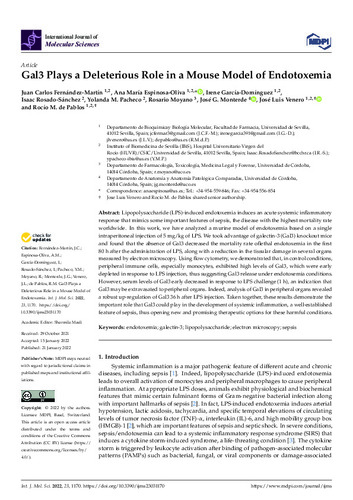
Lipopolysaccharide (LPS)-induced endotoxemia induces an acute systemic inflammatory response that mimics some important features of sepsis, the disease with the highest mortality rate worldwide. In this work, we have analyzed a murine model of endotoxemia based on a single intraperitoneal injection of 5 mg/kg of LPS. We took advantage of galectin-3 (Gal3) knockout mice and found that the absence of Gal3 decreased the mortality rate oflethal endotoxemia in the first 80 h after the administration of LPS, along with a reduction in the tissular damage in several organs measured by electron microscopy. Using flow cytometry, we demonstrated that, in control conditions, peripheral immune cells, especially monocytes, exhibited high levels of Gal3, which were early depleted in response to LPS injection, thus suggesting Gal3 release under endotoxemia conditions. However, serum levels of Gal3 early decreased in response to LPS challenge (1 h), an indication that Gal3 may be extravasated to peripheral organs. Indeed, analysis of Gal3 in peripheral organs revealed a robust up-regulation of Gal3 36 h after LPS injection. Taken together, these results demonstrate the important role that Gal3 could play in the development of systemic inflammation, a well-established feature of sepsis, thus opening new and promising therapeutic options for these harmful conditions.

Show full item record
Collections
  • Artículos
Files in this item
Thumbnail
Gal3.pdf (5.787Mb)
Share
Export to Mendeley
Statistics
Usage statistics
Metrics and citations  
Go to Brújula home

Universidad Loyola

Library

Contact

Facebook Loyola BibliotecaTwitter Loyola Biblioteca

The content of the Repository is protected with a Creative Commons license:

Attribution-NonCommercial-NoDerivatives 4.0 Internacional

Creative Commons Image