Brújula Home

Institutional repository of the Universidad Loyola

View Item 
  •   Brújula Home
  • PRODUCCIÓN CIENTÍFICA Y TRANSFERENCIA
  • Departamento Comunicación y Educación
  • Artículos
  • View Item
  •   Brújula Home
  • PRODUCCIÓN CIENTÍFICA Y TRANSFERENCIA
  • Departamento Comunicación y Educación
  • Artículos
  • View Item
    • español
    • English
JavaScript is disabled for your browser. Some features of this site may not work without it.

Browse

All of BrújulaCommunities and CollectionsAuthorsTitlesKeywordsAuthor profilesThis CollectionAuthorsTitlesKeywords

My Account

Login

Statistics

View Usage Statistics

Añadido Recientemente

Novedades
Repository
How to publish
Visibility
FAQs

Narrative Structures for the European Identity Crisis: Antiplot in Ulysses' Gaze, A Talking Picture and Our Music

Author:
Muñoz-Garnica, Miguel; Noguera, María
URI:
https://hdl.handle.net/20.500.12412/6348
ISSN:
1050-9208
DOI:
10.1080/10509208.2023.2218266
Date:
2023-06-04
Abstract:

This article studies three European films by renowned authors: Ulysses’ Gaze (Theo Angelopoulos, 1995), A Talking Picture (Manoel de Oliveira, 2003), and Our Music (Jean-Luc Godard, 2004). They share a vision of Europe in a state of identity crisis caused by its recent past of war and brutality. They show a gap between an uncertain present and a past rich in culture and mythology. This breach forces filmmakers to push the boundaries of plot linearity, favouring strategies of opposition and superimposition of temporal and reality layers, in a narrative form that McKee named antiplot. This notion guides the analysis of the three films. We consider that the break with the Aristotelian narrative canon implies the use of antiplots as a logical consequence of a cultural identity crisis. In Ulysses’ Gaze, the journey of the protagonist merges with several layers of time, memory, and History, which, through their juxtaposition, manage to create a cohesive story. In A Talking Picture, a sea voyage runs in parallel to the reconstruction of the European past glories, to the extent that the secondary storyline determines the meaning of the former. Finally, Our Music emulates the tripartite division of Dante’s Divine Comedy to explore, through an apparent separation of its parts, the truncated dialogue with the foundational values of Europe.

This article studies three European films by renowned authors: Ulysses’ Gaze (Theo Angelopoulos, 1995), A Talking Picture (Manoel de Oliveira, 2003), and Our Music (Jean-Luc Godard, 2004). They share a vision of Europe in a state of identity crisis caused by its recent past of war and brutality. They show a gap between an uncertain present and a past rich in culture and mythology. This breach forces filmmakers to push the boundaries of plot linearity, favouring strategies of opposition and superimposition of temporal and reality layers, in a narrative form that McKee named antiplot. This notion guides the analysis of the three films. We consider that the break with the Aristotelian narrative canon implies the use of antiplots as a logical consequence of a cultural identity crisis. In Ulysses’ Gaze, the journey of the protagonist merges with several layers of time, memory, and History, which, through their juxtaposition, manage to create a cohesive story. In A Talking Picture, a sea voyage runs in parallel to the reconstruction of the European past glories, to the extent that the secondary storyline determines the meaning of the former. Finally, Our Music emulates the tripartite division of Dante’s Divine Comedy to explore, through an apparent separation of its parts, the truncated dialogue with the foundational values of Europe.


Es la versión preprint del artículo. Se puede consultar la versión final en https://doi.org/10.1080/10509208.2023.2218266
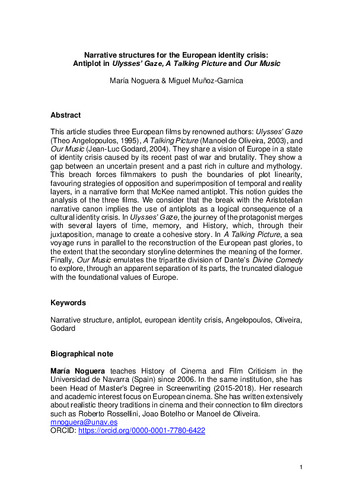
Es la versión preprint del artículo. Se puede consultar la versión final en https://doi.org/10.1080/10509208.2023.2218266

 
Show full item record
Collections
  • Artículos
Files in this item
Thumbnail
Preprint (905.9Kb)
Share
Export to Mendeley
Statistics
Usage statistics
Metrics and citations  
Go to Brújula home

Universidad Loyola

Library

Contact

Facebook Loyola BibliotecaTwitter Loyola Biblioteca

The content of the Repository is protected with a Creative Commons license:

Attribution-NonCommercial-NoDerivatives 4.0 Internacional

Creative Commons Image