Brújula Home

Institutional repository of the Universidad Loyola

View Item 
  •   Brújula Home
  • PRODUCCIÓN CIENTÍFICA Y TRANSFERENCIA
  • Departamento Ciencias Clínicas y de la Salud
  • Artículos
  • View Item
  •   Brújula Home
  • PRODUCCIÓN CIENTÍFICA Y TRANSFERENCIA
  • Departamento Ciencias Clínicas y de la Salud
  • Artículos
  • View Item
    • español
    • English
JavaScript is disabled for your browser. Some features of this site may not work without it.

Browse

All of BrújulaCommunities and CollectionsAuthorsTitlesKeywordsAuthor profilesThis CollectionAuthorsTitlesKeywords

My Account

Login

Statistics

View Usage Statistics

Añadido Recientemente

Novedades
Repository
How to publish
Visibility
FAQs

Effect of Steam Injection during Carbonation on the Multicyclic Performance of Limestone (CaCO3) under Different Calcium Looping Conditions: A Comparative Study

Author:
Arcenegui-Troya, Juan; Moreno, Virginia; Sánchez-Jiménez, Pedro Enrique; Perejón, Antonio; Valverde, José Manuel; [et al.]
URI:
https://hdl.handle.net/20.500.12412/6389
ISSN:
2168-0485
DOI:
10.1021/acssuschemeng.1c06314
Date:
2022-01-17
Keyword(s):

Calcium looping

CO2capture

Concentrated solar power

Steam

Thermochemical energy storage

Abstract:

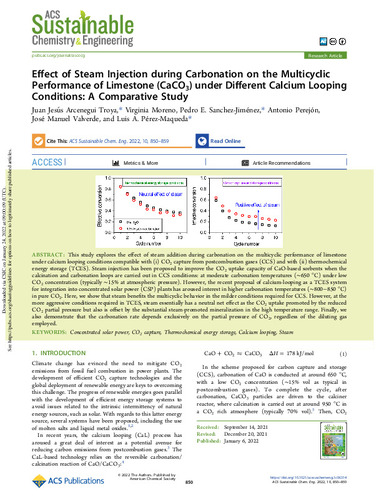
This study explores the effect of steam addition during carbonation on the multicyclic performance of limestone under calcium looping conditions compatible with (i) CO2 capture from postcombustion gases (CCS) and with (ii) thermochemical energy storage (TCES). Steam injection has been proposed to improve the CO2 uptake capacity of CaO-based sorbents when the calcination and carbonation loops are carried out in CCS conditions: at moderate carbonation temperatures (∼650 °C) under low CO2 concentration (typically ∼15% at atmospheric pressure). However, the recent proposal of calcium-looping as a TCES system for integration into concentrated solar power (CSP) plants has aroused interest in higher carbonation temperatures (∼800-850 °C) in pure CO2. Here, we show that steam benefits the multicyclic behavior in the milder conditions required for CCS. However, at the more aggressive conditions required in TCES, steam essentially has a neutral net effect as the CO2 uptake promoted by the reduced CO2 partial pressure but also is offset by the substantial steam-promoted mineralization in the high temperature range. Finally, we also demonstrate that the carbonation rate depends exclusively on the partial pressure of CO2, regardless of the diluting gas employed.

This study explores the effect of steam addition during carbonation on the multicyclic performance of limestone under calcium looping conditions compatible with (i) CO2 capture from postcombustion gases (CCS) and with (ii) thermochemical energy storage (TCES). Steam injection has been proposed to improve the CO2 uptake capacity of CaO-based sorbents when the calcination and carbonation loops are carried out in CCS conditions: at moderate carbonation temperatures (∼650 °C) under low CO2 concentration (typically ∼15% at atmospheric pressure). However, the recent proposal of calcium-looping as a TCES system for integration into concentrated solar power (CSP) plants has aroused interest in higher carbonation temperatures (∼800-850 °C) in pure CO2. Here, we show that steam benefits the multicyclic behavior in the milder conditions required for CCS. However, at the more aggressive conditions required in TCES, steam essentially has a neutral net effect as the CO2 uptake promoted by the reduced CO2 partial pressure but also is offset by the substantial steam-promoted mineralization in the high temperature range. Finally, we also demonstrate that the carbonation rate depends exclusively on the partial pressure of CO2, regardless of the diluting gas employed.

Show full item record
Collections
  • Artículos
Files in this item
Thumbnail
11.Effect of steam.pdf (5.319Mb)
Share
Export to Mendeley
Statistics
Usage statistics
Metrics and citations  
Go to Brújula home

Universidad Loyola

Library

Contact

Facebook Loyola BibliotecaTwitter Loyola Biblioteca

The content of the Repository is protected with a Creative Commons license:

Attribution-NonCommercial-NoDerivatives 4.0 Internacional

Creative Commons Image