Brújula Home

Institutional repository of the Universidad Loyola

View Item 
  •   Brújula Home
  • PRODUCCIÓN CIENTÍFICA Y TRANSFERENCIA
  • Departamento Estudios Internacionales
  • Artículos
  • View Item
  •   Brújula Home
  • PRODUCCIÓN CIENTÍFICA Y TRANSFERENCIA
  • Departamento Estudios Internacionales
  • Artículos
  • View Item
    • español
    • English
JavaScript is disabled for your browser. Some features of this site may not work without it.

Browse

All of BrújulaCommunities and CollectionsAuthorsTitlesKeywordsAuthor profilesThis CollectionAuthorsTitlesKeywords

My Account

Login

Statistics

View Usage Statistics

Añadido Recientemente

Novedades
Repository
How to publish
Visibility
FAQs

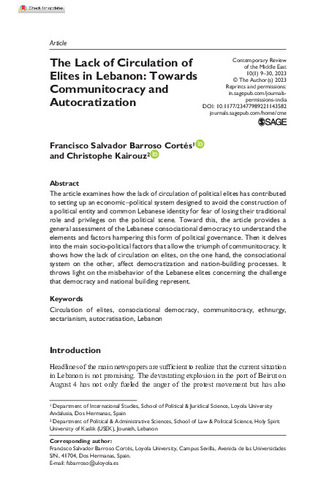
The Lack of Circulation of Elites in Lebanon: Towards Communitocracy and Autocratization

Author:
Barroso Cortés, Francisco Salvador; Kayrouz, Christophe
URI:
https://hdl.handle.net/20.500.12412/6461
ISSN:
2347-7989
DOI:
10.1177/23477989221143582
Date:
2023
Keyword(s):

Circulation of elites

Consociational democracy

Communitocracy

Ethnurgy

Sectarianism

Autocratisation

Lebanon

Abstract:

The article examines how the lack of circulation of political elites has contributed to setting up an economic–political system designed to avoid the construction of a political entity and common Lebanese identity for fear of losing their traditional role and privileges on the political scene. Toward this, the article provides a general assessment of the Lebanese consociational democracy to understand the elements and factors hampering this form of political governance. Then it delves into the main socio-political factors that allow the triumph of communitocracy. It shows how the lack of circulation on elites, on the one hand, the consociational system on the other, affect democratization and nation-building processes. It throws light on the misbehavior of the Lebanese elites concerning the challenge that democracy and national building represent.

The article examines how the lack of circulation of political elites has contributed to setting up an economic–political system designed to avoid the construction of a political entity and common Lebanese identity for fear of losing their traditional role and privileges on the political scene. Toward this, the article provides a general assessment of the Lebanese consociational democracy to understand the elements and factors hampering this form of political governance. Then it delves into the main socio-political factors that allow the triumph of communitocracy. It shows how the lack of circulation on elites, on the one hand, the consociational system on the other, affect democratization and nation-building processes. It throws light on the misbehavior of the Lebanese elites concerning the challenge that democracy and national building represent.

Show full item record
Collections
  • Artículos
Files in this item
Thumbnail
cortes-kairouz-2023-the-lack-of-circulation-of-elites-in-lebanon-towards-communitocracy-and-autocratization.pdf (679.1Kb)
Share
Export to Mendeley
Statistics
Usage statistics
Metrics and citations  
Go to Brújula home

Universidad Loyola

Library

Contact

Facebook Loyola BibliotecaTwitter Loyola Biblioteca

The content of the Repository is protected with a Creative Commons license:

Attribution-NonCommercial-NoDerivatives 4.0 Internacional

Creative Commons Image