Brújula Home

Institutional repository of the Universidad Loyola

View Item 
  •   Brújula Home
  • PRODUCCIÓN CIENTÍFICA Y TRANSFERENCIA
  • Departamento Estudios Internacionales
  • Artículos
  • View Item
  •   Brújula Home
  • PRODUCCIÓN CIENTÍFICA Y TRANSFERENCIA
  • Departamento Estudios Internacionales
  • Artículos
  • View Item
    • español
    • English
JavaScript is disabled for your browser. Some features of this site may not work without it.

Browse

All of BrújulaCommunities and CollectionsAuthorsTitlesKeywordsAuthor profilesThis CollectionAuthorsTitlesKeywords

My Account

Login

Statistics

View Usage Statistics

Añadido Recientemente

Novedades
Repository
How to publish
Visibility
FAQs

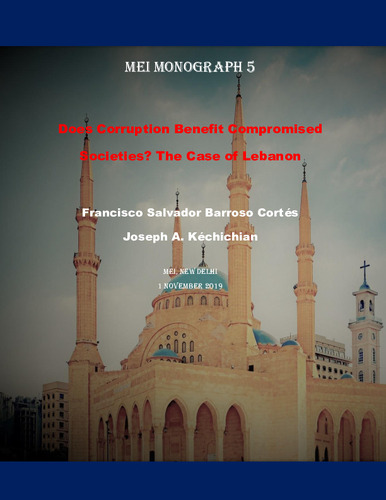
Does corruption benefit compromised societies?: The case of Lebanon

Author:
Barroso Cortés, Francisco Salvador; Kéchichian, Joseph A.
URI:
https://hdl.handle.net/20.500.12412/6463
Date:
2019
Keyword(s):

Corruption

Compromised societies

Hybrid political order

Political clientelism

Lebanon

Abstract:

This monograph explores the pervasive issue of corruption in Lebanon, examining its socio-political and economic dimensions within the country's confessional governance system. The study questions whether corruption, paradoxically, offers functional benefits to compromised societies like Lebanon. The authors provide a historical and theoretical analysis of corruption, highlighting its integration into Lebanese political and societal norms. They discuss the evolution of patronage networks, sectarian-based governance, and the socio-economic consequences of corruption. Through the lens of theoretical frameworks, the monograph sheds light on how political elites and communities navigate a system where ethical compromises are often justified under sectarian loyalties. The study concludes that while corruption may facilitate short-term stability, it undermines long-term governance and economic growth, necessitating comprehensive reforms for sustainable state-building.

This monograph explores the pervasive issue of corruption in Lebanon, examining its socio-political and economic dimensions within the country's confessional governance system. The study questions whether corruption, paradoxically, offers functional benefits to compromised societies like Lebanon. The authors provide a historical and theoretical analysis of corruption, highlighting its integration into Lebanese political and societal norms. They discuss the evolution of patronage networks, sectarian-based governance, and the socio-economic consequences of corruption. Through the lens of theoretical frameworks, the monograph sheds light on how political elites and communities navigate a system where ethical compromises are often justified under sectarian loyalties. The study concludes that while corruption may facilitate short-term stability, it undermines long-term governance and economic growth, necessitating comprehensive reforms for sustainable state-building.

Show full item record
Collections
  • Artículos
Files in this item
Thumbnail
192-1572530385-analyses-monograph.pdf (835.8Kb)
Share
Export to Mendeley
Statistics
Usage statistics
Metrics and citations
Go to Brújula home

Universidad Loyola

Library

Contact

Facebook Loyola BibliotecaTwitter Loyola Biblioteca

The content of the Repository is protected with a Creative Commons license:

Attribution-NonCommercial-NoDerivatives 4.0 Internacional

Creative Commons Image