Brújula Home

Institutional repository of the Universidad Loyola

View Item 
  •   Brújula Home
  • PRODUCCIÓN CIENTÍFICA Y TRANSFERENCIA
  • Departamento Economía
  • Artículos
  • View Item
  •   Brújula Home
  • PRODUCCIÓN CIENTÍFICA Y TRANSFERENCIA
  • Departamento Economía
  • Artículos
  • View Item
    • español
    • English
JavaScript is disabled for your browser. Some features of this site may not work without it.

Browse

All of BrújulaCommunities and CollectionsAuthorsTitlesKeywordsAuthor profilesThis CollectionAuthorsTitlesKeywords

My Account

Login

Statistics

View Usage Statistics

Añadido Recientemente

Novedades
Repository
How to publish
Visibility
FAQs

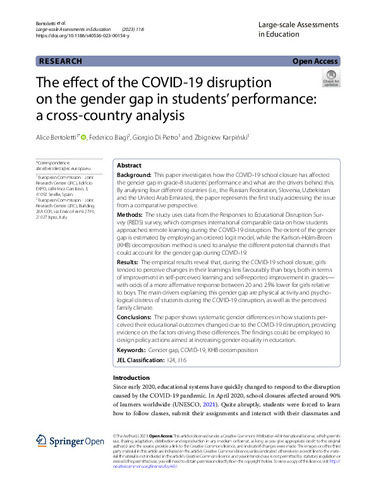
The effect of the COVID‑19 disruption on the gender gap in students’ performance: a cross‑country analysis

Author:
Bertoletti, Alice; Biagi, Federico; Di Pietro, Giorgio; Karpiński, Zbigniew
URI:
https://hdl.handle.net/20.500.12412/6916
ISSN:
2196-0739
DOI:
10.1186/s40536-023-00154-y
Date:
2023
Keyword(s):

Gender gap

COVID-19

KHB decomposition

Abstract:

This paper investigates how the COVID-19 school closure has affected the gender gap in grade-8 students' performance and what are the drivers behind this. By analysing four different countries (i.e., the Russian Federation, Slovenia, Uzbekistan and the United Arab Emirates), the paper represents the first study addressing the issue from a comparative perspective.The study uses data from the Responses to Educational Disruption Survey (REDS) survey, which comprises international comparable data on how students approached remote learning during the COVID-19 disruption. The extent of the gender gap is estimated by employing an ordered logit model, while the Karlson-Holm-Breen (KHB) decomposition method is used to analyse the different potential channels that could account for the gender gap during COVID-19. The empirical results reveal that, during the COVID-19 school closure, girls tended to perceive changes in their learnings less favourably than boys, both in terms of improvement in self-perceived learning and self-reported improvement in grades— with odds of a more affirmative response between 20 and 25% lower for girls relative to boys. The main drivers explaining this gender gap are physical activity and psychological distress of students during the COVID-19 disruption, as well as the perceived family climate.

This paper investigates how the COVID-19 school closure has affected the gender gap in grade-8 students' performance and what are the drivers behind this. By analysing four different countries (i.e., the Russian Federation, Slovenia, Uzbekistan and the United Arab Emirates), the paper represents the first study addressing the issue from a comparative perspective.The study uses data from the Responses to Educational Disruption Survey (REDS) survey, which comprises international comparable data on how students approached remote learning during the COVID-19 disruption. The extent of the gender gap is estimated by employing an ordered logit model, while the Karlson-Holm-Breen (KHB) decomposition method is used to analyse the different potential channels that could account for the gender gap during COVID-19. The empirical results reveal that, during the COVID-19 school closure, girls tended to perceive changes in their learnings less favourably than boys, both in terms of improvement in self-perceived learning and self-reported improvement in grades— with odds of a more affirmative response between 20 and 25% lower for girls relative to boys. The main drivers explaining this gender gap are physical activity and psychological distress of students during the COVID-19 disruption, as well as the perceived family climate.

Show full item record
Collections
  • Artículos
Files in this item
Thumbnail
s40536-023-00154-y.pdf (1.294Mb)
Share
Export to Mendeley
Statistics
Usage statistics
Metrics and citations  
Go to Brújula home

Universidad Loyola

Library

Contact

Facebook Loyola BibliotecaTwitter Loyola Biblioteca

The content of the Repository is protected with a Creative Commons license:

Attribution-NonCommercial-NoDerivatives 4.0 Internacional

Creative Commons Image