Brújula Home

Institutional repository of the Universidad Loyola

View Item 
  •   Brújula Home
  • PRODUCCIÓN CIENTÍFICA Y TRANSFERENCIA
  • Departamento Economía
  • Artículos
  • View Item
  •   Brújula Home
  • PRODUCCIÓN CIENTÍFICA Y TRANSFERENCIA
  • Departamento Economía
  • Artículos
  • View Item
    • español
    • English
JavaScript is disabled for your browser. Some features of this site may not work without it.

Browse

All of BrújulaCommunities and CollectionsAuthorsTitlesKeywordsAuthor profilesThis CollectionAuthorsTitlesKeywords

My Account

Login

Statistics

View Usage Statistics

Añadido Recientemente

Novedades
Repository
How to publish
Visibility
FAQs

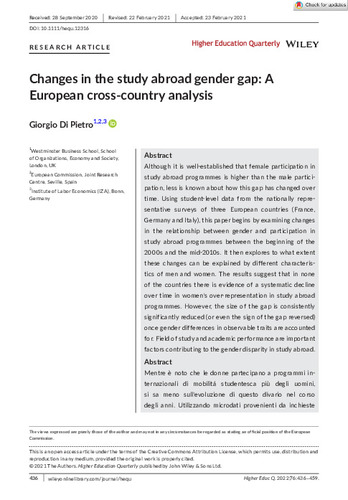
Changes in the study abroad gender gap: A European cross-country analysis

Author:
Di Pietro, Giorgio
URI:
https://hdl.handle.net/20.500.12412/6920
ISSN:
0951-5224
DOI:
10.1111/hequ.12316
Date:
2022
Abstract:

Although it is well-established that female participation in abroad programmes is higher than the male participation, less is known about how this gap has changed over time. Using student-level data from the nationally representative surveys of three European countries (France, Germany and Italy), this paper begins by examining changes in the relationship between gender and participation in study abroad programmes between the beginning of the 2000s and the mid-2010s. It then explores to what extent these changes can be explained by different characteristics of men and women. The results suggest that in none of the countries there is evidence of a systematic decline over time in women'sover-representation in study abroad programmes. However, the size of the gap is consistently significantly reduced (or even the sign of the gap reversed) once gender differences in observable traits are accounted for. Field of study and academic performance are important factors contributing to the gender disparity in study abroad.

Although it is well-established that female participation in abroad programmes is higher than the male participation, less is known about how this gap has changed over time. Using student-level data from the nationally representative surveys of three European countries (France, Germany and Italy), this paper begins by examining changes in the relationship between gender and participation in study abroad programmes between the beginning of the 2000s and the mid-2010s. It then explores to what extent these changes can be explained by different characteristics of men and women. The results suggest that in none of the countries there is evidence of a systematic decline over time in women'sover-representation in study abroad programmes. However, the size of the gap is consistently significantly reduced (or even the sign of the gap reversed) once gender differences in observable traits are accounted for. Field of study and academic performance are important factors contributing to the gender disparity in study abroad.

Show full item record
Collections
  • Artículos
Files in this item
Thumbnail
Higher Education Quarterly - 2021 - Di Pietro - Changes in the study abroad gender gap A European cross‐country analysis.pdf (755.4Kb)
Share
Export to Mendeley
Statistics
Usage statistics
Metrics and citations  
Go to Brújula home

Universidad Loyola

Library

Contact

Facebook Loyola BibliotecaTwitter Loyola Biblioteca

The content of the Repository is protected with a Creative Commons license:

Attribution-NonCommercial-NoDerivatives 4.0 Internacional

Creative Commons Image