Brújula Home

Institutional repository of the Universidad Loyola

View Item 
  •   Brújula Home
  • PRODUCCIÓN CIENTÍFICA Y TRANSFERENCIA
  • Departamento Economía
  • Artículos
  • View Item
  •   Brújula Home
  • PRODUCCIÓN CIENTÍFICA Y TRANSFERENCIA
  • Departamento Economía
  • Artículos
  • View Item
    • español
    • English
JavaScript is disabled for your browser. Some features of this site may not work without it.

Browse

All of BrújulaCommunities and CollectionsAuthorsTitlesKeywordsAuthor profilesThis CollectionAuthorsTitlesKeywords

My Account

Login

Statistics

View Usage Statistics

Añadido Recientemente

Novedades
Repository
How to publish
Visibility
FAQs

Imported inputs and export growth: Evidence from Tunisia

Author:
Di Pietro, Giorgio
URI:
https://hdl.handle.net/20.500.12412/6922
ISSN:
1594-5685
Date:
2001
Abstract:

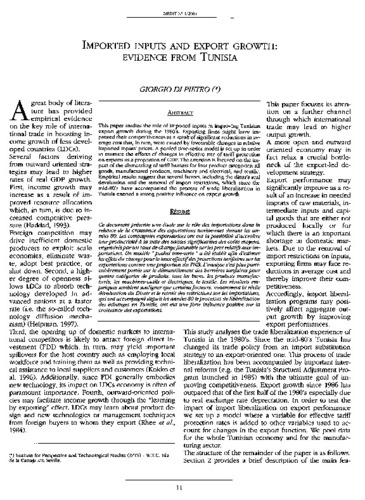
This paper studies the role of imported inputs in improving Tunisian export growth during the 1980's. Exporting firms might have improved their competitiveness as a result of significant reductions in average cost that, in turn, were caused by favourdble changes in relative imported inputs' prices. A pooled time-series model is set up in order to estimate the effects of changes in effective rate of tariff protection on exports as a proportion of GDP. The attention is focused on the impact of the dismantling of tariff barriers for four product categories: all goods, manufactured products, machinery and electrical, and textile. Empirical results suggest that several factors, including the dinar's real devaluation and the removal of import restrictions, which since the mid-80's have accompanied the process of trade liberalisation in Tunisia exerted a strong positive influence on export growth.

This paper studies the role of imported inputs in improving Tunisian export growth during the 1980's. Exporting firms might have improved their competitiveness as a result of significant reductions in average cost that, in turn, were caused by favourdble changes in relative imported inputs' prices. A pooled time-series model is set up in order to estimate the effects of changes in effective rate of tariff protection on exports as a proportion of GDP. The attention is focused on the impact of the dismantling of tariff barriers for four product categories: all goods, manufactured products, machinery and electrical, and textile. Empirical results suggest that several factors, including the dinar's real devaluation and the removal of import restrictions, which since the mid-80's have accompanied the process of trade liberalisation in Tunisia exerted a strong positive influence on export growth.

Show full item record
Collections
  • Artículos
Files in this item
Thumbnail
This is the version that can be downloaded from the journal´s web site (https://newmedit.ciheam.org/edizioni_new_medit,229,229,2001,119,608,imported-inputs-and-export-growth:-evidence-from-tunisia.htm) (525.4Kb)
Share
Export to Mendeley
Statistics
Usage statistics
Metrics and citations
Go to Brújula home

Universidad Loyola

Library

Contact

Facebook Loyola BibliotecaTwitter Loyola Biblioteca

The content of the Repository is protected with a Creative Commons license:

Attribution-NonCommercial-NoDerivatives 4.0 Internacional

Creative Commons Image