
Design and Deployment of a Cloud Platform for Data-Driven Leak Detection in Agricultural Irrigation Systems
Author:
Manzano Crespo, José María; Neto, F.M.; Tapia Córdoba, Alejandro ; Orihuela Espina, Diego Luis
Date:
2025-02-06Abstract:
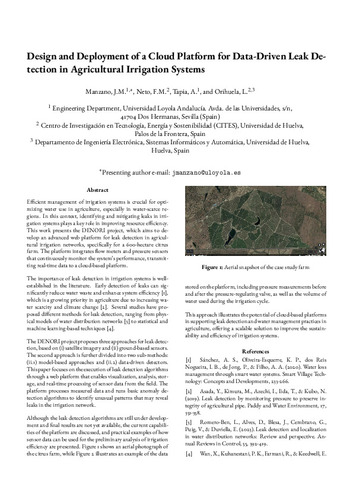
Efficient management of irrigation systems is crucial for optimizing water use in agriculture, especially in water-scarce regions. In this context, identifying and mitigating leaks in irrigation systems plays a key role in improving resource efficiency. This work presents the DENORI project, which aims to develop an advanced web platform for leak detection in agricultural irrigation networks, specifically for a 600-hectare citrus farm. The platform integrates flow meters and pressure sensors that continuously monitor the system’s performance, transmitting real-time data to a cloud-based platform. The importance of leak detection in irrigation systems is well-established in the literature. Early detection of leaks can significantly reduce water waste and enhance system efficiency, which is a growing priority in agriculture due to increasing water scarcity and climate change. Several studies have proposed different methods for leak detection, ranging from physical models of water distribution networks to statistical and machine learning-based techniques. The DENORI project proposes three approaches for leak detection, based on (i) satellite imagery and (ii) ground-based sensors. The second approach is further divided into two sub-methods: (ii.1) model-based approaches and (ii.2) data-driven detectors. This paper focuses on the execution of leak detection algorithms through a web platform that enables visualization, analysis, storage, and real-time processing of sensor data from the field. The platform processes measured data and runs basic anomaly detection algorithms to identify unusual patterns that may reveal leaks in the irrigation network. Although the leak detection algorithms are still under development and final results are not yet available, the current capabilities of the platform are discussed, and practical examples of how sensor data can be used for the preliminary analysis of irrigation efficiency are presented. This approach illustrates the potential of cloud-based platforms in supporting leak detection and water management practices in agriculture, offering a scalable solution to improve the sustainability and efficiency of irrigation systems.
Collections
Files in this item
Share

Statistics
