Brújula Home

Institutional repository of the Universidad Loyola

View Item 
  •   Brújula Home
  • PRODUCCIÓN CIENTÍFICA Y TRANSFERENCIA
  • Departamento de Salud
  • Artículos
  • View Item
  •   Brújula Home
  • PRODUCCIÓN CIENTÍFICA Y TRANSFERENCIA
  • Departamento de Salud
  • Artículos
  • View Item
    • español
    • English
JavaScript is disabled for your browser. Some features of this site may not work without it.

Browse

All of BrújulaCommunities and CollectionsAuthorsTitlesKeywordsAuthor profilesThis CollectionAuthorsTitlesKeywords

My Account

Login

Statistics

View Usage Statistics

Añadido Recientemente

Novedades
Repository
How to publish
Visibility
FAQs

Efficacy of linezolid compared to vancomycin in an experimental model of pneumonia induced by methicillin-resistant Staphylococcus aureus in ventilated pigs.

Author:
Martínez - Olondris, Pilar; Rigol, Montserrat; Soy, D; Guerrero, L; Agustí, C; [et al.]
URI:
https://hdl.handle.net/20.500.12412/6976
ISSN:
0090-3493
Date:
2012-01
Keyword(s):

Pneumonia

Linezolid

Vancomycin

Abstract:

Objective: To assess the efficacy of linezolid compared with vancomycin in an experimental model of pneumonia induced by methicillinresistant Staphylococcus aureus (MRSA) in ventilated pigs. Methods: Forty pigs (30 kg) were intubated and challenged via bronchoscopy with a suspension of 106 colony forming units of MRSA into every lobe. Afterwards, pigs were ventilated up to 96 hours. Twelve hours after bacterial inoculation, the animals were randomized into 4 groups of treatment: group 1, control; group 2, vancomycin twice daily; group 3, continuous infusion of vancomycin; and group 4, linezolid. Clinical and laboratory parameters were monitored throughout the study. Bacterial cultures of bronchoalveolar lavage fluid and lung tissue samples were performed at the end of the study. Measurements of histopathology derangements of lung samples and studies of intrapulmonary drug penetration were performed. Results: A total of 34 animals completed the study. No differences in clinical and laboratory parameters were observed. The percentage of bronchoalveolar lavage fluid and lung tissue samples with positive cultures for MRSA in controls and groups 2, 3, and 4 was respectively 75%, 11%, 11%, and 0% (p < .01); 52%, 9%, 24%, and 2.5% (p < .01). Histopathology studies demonstrated signs of pneumonia in 95%, 69%, 58%, and 57% and signs of severe pneumonia in 48%, 29%, 22%, and 0% of controls and groups 2, 3, and 4, respectively (p < .01). In addition, pharmacokinetics/ pharmacodynamics profile in serum and lung tissue showed better results for linezolid compared with both vancomycin treatments. Conclusions: In this animal model of MRSA pneumonia, linezolid showed a better efficacy than vancomycin showed because of a better pharmacokinetics/pharmacodynamics index.
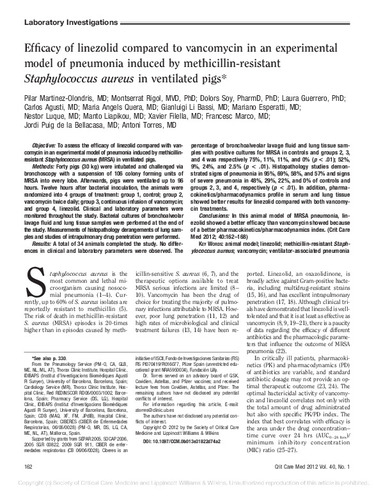
Objective: To assess the efficacy of linezolid compared with vancomycin in an experimental model of pneumonia induced by methicillinresistant Staphylococcus aureus (MRSA) in ventilated pigs. Methods: Forty pigs (30 kg) were intubated and challenged via bronchoscopy with a suspension of 106 colony forming units of MRSA into every lobe. Afterwards, pigs were ventilated up to 96 hours. Twelve hours after bacterial inoculation, the animals were randomized into 4 groups of treatment: group 1, control; group 2, vancomycin twice daily; group 3, continuous infusion of vancomycin; and group 4, linezolid. Clinical and laboratory parameters were monitored throughout the study. Bacterial cultures of bronchoalveolar lavage fluid and lung tissue samples were performed at the end of the study. Measurements of histopathology derangements of lung samples and studies of intrapulmonary drug penetration were performed. Results: A total of 34 animals completed the study. No differences in clinical and laboratory parameters were observed. The percentage of bronchoalveolar lavage fluid and lung tissue samples with positive cultures for MRSA in controls and groups 2, 3, and 4 was respectively 75%, 11%, 11%, and 0% (p < .01); 52%, 9%, 24%, and 2.5% (p < .01). Histopathology studies demonstrated signs of pneumonia in 95%, 69%, 58%, and 57% and signs of severe pneumonia in 48%, 29%, 22%, and 0% of controls and groups 2, 3, and 4, respectively (p < .01). In addition, pharmacokinetics/ pharmacodynamics profile in serum and lung tissue showed better results for linezolid compared with both vancomycin treatments. Conclusions: In this animal model of MRSA pneumonia, linezolid showed a better efficacy than vancomycin showed because of a better pharmacokinetics/pharmacodynamics index.

Show full item record
Collections
  • Artículos
Files in this item
Thumbnail
Artículo (635.7Kb)
Share
Export to Mendeley
Statistics
Usage statistics
Metrics and citations
Go to Brújula home

Universidad Loyola

Library

Contact

Facebook Loyola BibliotecaTwitter Loyola Biblioteca

The content of the Repository is protected with a Creative Commons license:

Attribution-NonCommercial-NoDerivatives 4.0 Internacional

Creative Commons Image