Brújula Home

Institutional repository of the Universidad Loyola

View Item 
  •   Brújula Home
  • PRODUCCIÓN CIENTÍFICA Y TRANSFERENCIA
  • Departamento de Salud
  • Artículos
  • View Item
  •   Brújula Home
  • PRODUCCIÓN CIENTÍFICA Y TRANSFERENCIA
  • Departamento de Salud
  • Artículos
  • View Item
    • español
    • English
JavaScript is disabled for your browser. Some features of this site may not work without it.

Browse

All of BrújulaCommunities and CollectionsAuthorsTitlesKeywordsAuthor profilesThis CollectionAuthorsTitlesKeywords

My Account

Login

Statistics

View Usage Statistics

Añadido Recientemente

Novedades
Repository
How to publish
Visibility
FAQs

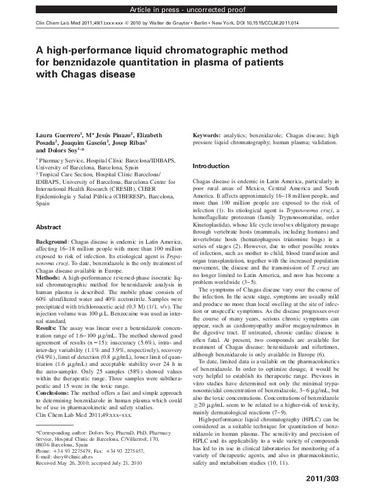
A high-performance liquid chromatographic method for benznidazole quantitation in plasma of Chagas disease patients

Author:
Guerrero, Laura; Pinazo, Maria Jesús; Posada, Elizabet; Gascón, Joaquim; Ribas, Josep; [et al.]
URI:
https://hdl.handle.net/20.500.12412/6977
ISSN:
1437-4331
Date:
2011-07-21
Keyword(s):

HPLC

Benznidazole

Plasma

Abstract:

Background: Chagas disease is endemic in Latin America, affecting 16–18 million people with more than 100 million exposed to risk of infection. Its etiological agent is Trypanosoma cruzi. To date, benznidazole is the only treatment of Chagas disease available in Europe. Methods: A high-performance reversed-phase isocratic liquid chromatographic method for benznidazole analysis in human plasma is described. The mobile phase consists of 60% ultrafiltered water and 40% acetonitrile. Samples were precipitated with trichloroacetic acid (0.3 M) (1/1, v/v). The injection volume was 100 mL. Benzocaine was used as internal standard. Results: The assay was linear over a benznidazole concentration range of 1.6–100 mg/mL. The method showed good agreement of results (ns15): inaccuracy (5.6%), intra- and inter-day variability (1.1% and 3.9%, respectively), recovery (94.9%), limit of detection (0.8 mg/mL), lower limit of quantitation (1.6 mg/mL) and acceptable stability over 24 h in the auto-sampler. Only 25 samples (58%) showed values within the therapeutic range. Three samples were subtherapeutic and 15 were in the toxic range. Conclusions: The method offers a fast and simple approach to determining benznidazole in human plasma which could be of use in pharmacokinetic and safety studies.

Background: Chagas disease is endemic in Latin America, affecting 16–18 million people with more than 100 million exposed to risk of infection. Its etiological agent is Trypanosoma cruzi. To date, benznidazole is the only treatment of Chagas disease available in Europe. Methods: A high-performance reversed-phase isocratic liquid chromatographic method for benznidazole analysis in human plasma is described. The mobile phase consists of 60% ultrafiltered water and 40% acetonitrile. Samples were precipitated with trichloroacetic acid (0.3 M) (1/1, v/v). The injection volume was 100 mL. Benzocaine was used as internal standard. Results: The assay was linear over a benznidazole concentration range of 1.6–100 mg/mL. The method showed good agreement of results (ns15): inaccuracy (5.6%), intra- and inter-day variability (1.1% and 3.9%, respectively), recovery (94.9%), limit of detection (0.8 mg/mL), lower limit of quantitation (1.6 mg/mL) and acceptable stability over 24 h in the auto-sampler. Only 25 samples (58%) showed values within the therapeutic range. Three samples were subtherapeutic and 15 were in the toxic range. Conclusions: The method offers a fast and simple approach to determining benznidazole in human plasma which could be of use in pharmacokinetic and safety studies.


Es la versióna prepront del artículo. Se puede consultar la versión final en https://doi.org/10.1515/CCLM.2011.014
Es la versióna prepront del artículo. Se puede consultar la versión final en https://doi.org/10.1515/CCLM.2011.014

 
Show full item record
Collections
  • Artículos
Files in this item
Thumbnail
Artículo (169.5Kb)
Share
Export to Mendeley
Statistics
Usage statistics
Metrics and citations
Go to Brújula home

Universidad Loyola

Library

Contact

Facebook Loyola BibliotecaTwitter Loyola Biblioteca

The content of the Repository is protected with a Creative Commons license:

Attribution-NonCommercial-NoDerivatives 4.0 Internacional

Creative Commons Image