Brújula Home

Institutional repository of the Universidad Loyola

View Item 
  •   Brújula Home
  • PRODUCCIÓN CIENTÍFICA Y TRANSFERENCIA
  • Departamento Métodos Cuantitativos
  • Artículos
  • View Item
  •   Brújula Home
  • PRODUCCIÓN CIENTÍFICA Y TRANSFERENCIA
  • Departamento Métodos Cuantitativos
  • Artículos
  • View Item
    • español
    • English
JavaScript is disabled for your browser. Some features of this site may not work without it.

Browse

All of BrújulaCommunities and CollectionsAuthorsTitlesKeywordsAuthor profilesThis CollectionAuthorsTitlesKeywords

My Account

Login

Statistics

View Usage Statistics

Añadido Recientemente

Novedades
Repository
How to publish
Visibility
FAQs

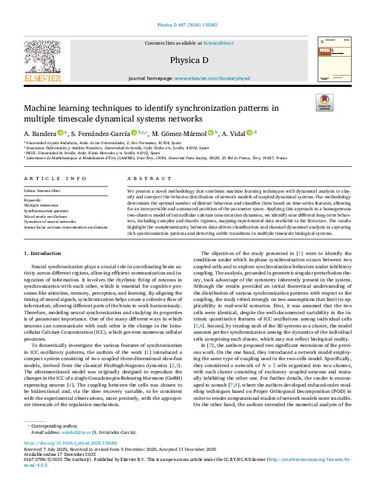
Machine learning techniques to identify synchronization patterns in multiple timescale dynamical systems networks

Author:
Bandera Moreno, Alejandro; Fernandez-García, Soledad; Gómez-Mármol, Macarena; Vidal, Alexandre
URI:
https://hdl.handle.net/20.500.12412/7061
ISSN:
0167-2789
DOI:
10.1016/j.physd.2025.135082
Date:
2026-03
Keyword(s):

Multiple timescales

Synchronization patterns

Mixed mode oscillations

Dynamics of neural networks

Intracellular calcium concentration oscillations

Abstract:

We present a novel methodology that combines machine learning techniques with dynamical analysis to classify and interpret the behavior distribution of network models of coupled dynamical systems. Our methodology determines the optimal number of distinct behaviors and classifies them based on time-series features, allowing for an interpretable and automated partition of the parameter space. Applying this approach to a homogeneous two-clusters model of intracellular calcium concentration dynamics, we identify nine different long-term behaviors, including complex and chaotic regimes, mapping experimental data available in the literature. The results highlight the complementarity between data-driven classification and classical dynamical analysis in capturing rich synchronization patterns and detecting subtle transitions in multiple timescale biological systems.

We present a novel methodology that combines machine learning techniques with dynamical analysis to classify and interpret the behavior distribution of network models of coupled dynamical systems. Our methodology determines the optimal number of distinct behaviors and classifies them based on time-series features, allowing for an interpretable and automated partition of the parameter space. Applying this approach to a homogeneous two-clusters model of intracellular calcium concentration dynamics, we identify nine different long-term behaviors, including complex and chaotic regimes, mapping experimental data available in the literature. The results highlight the complementarity between data-driven classification and classical dynamical analysis in capturing rich synchronization patterns and detecting subtle transitions in multiple timescale biological systems.

Show full item record
Collections
  • Artículos
Files in this item
Thumbnail
7.5 BFGV_MLSP_Published.pdf (6.466Mb)
Share
Export to Mendeley
Statistics
Usage statistics
Metrics and citations  
Go to Brújula home

Universidad Loyola

Library

Contact

Facebook Loyola BibliotecaTwitter Loyola Biblioteca

The content of the Repository is protected with a Creative Commons license:

Attribution-NonCommercial-NoDerivatives 4.0 Internacional

Creative Commons Image