Brújula Home

Institutional repository of the Universidad Loyola

View Item 
  •   Brújula Home
  • PRODUCCIÓN CIENTÍFICA Y TRANSFERENCIA
  • Departamento Psicología
  • Artículos
  • View Item
  •   Brújula Home
  • PRODUCCIÓN CIENTÍFICA Y TRANSFERENCIA
  • Departamento Psicología
  • Artículos
  • View Item
    • español
    • English
JavaScript is disabled for your browser. Some features of this site may not work without it.

Browse

All of BrújulaCommunities and CollectionsAuthorsTitlesKeywordsAuthor profilesThis CollectionAuthorsTitlesKeywords

My Account

Login

Statistics

View Usage Statistics

Añadido Recientemente

Novedades
Repository
How to publish
Visibility
FAQs

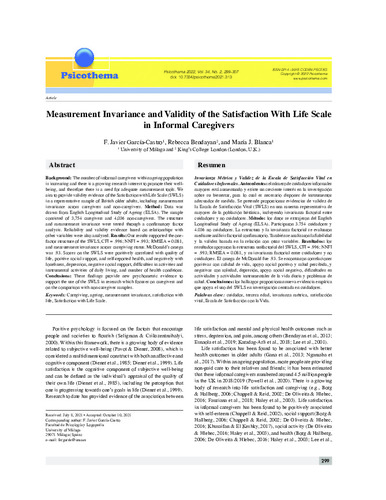
Measurement Invariance and Validity of the Satisfaction With Life Scale in Informal Caregivers

Author:
García-Castro, Fernando Javier; Bendayan, Rebecca; Blanca, María José
URI:
https://hdl.handle.net/20.500.12412/7088
ISSN:
0214 - 9915
DOI:
10.7334/psicothema2021.313
Date:
2022
Keyword(s):

Caregiving

Ageing

Measurement invariance

Aatisfaction with life

Satisfaction with Life Scale

Cuidados

Tercera edad

Invarianza métrica

Satisfacción vital

Escala de Satisfacción con la Vida.

Abstract:

Background: The number of informal caregivers within ageing population is increasing and there is a growing research interest to promote their well-being, and therefore there is a need for adequate measurement tools. We aim to provide validity evidence of the Satisfaction with Life Scale (SWLS) in a representative sample of British older adults, including measurement invariance across caregivers and non-caregivers. Method: Data was drawn from English Longitudinal Study of Ageing (ELSA). The sample consisted of 3,754 caregivers and 4,036 non-caregivers. The structure and measurement invariance were tested through a confirmatory factor analysis. Reliability and validity evidence based on relationships with other variables were also analysed. Results: Our results supported the one-factor structure of the SWLS, CFI = .996; NNFI = .993; RMSEA = 0.081, and measurement invariance across caregiving status. McDonald’s omega was .93. Scores on the SWLS were positively correlated with quality of life, positive social support, and self-reported health, and negatively with loneliness, depression, negative social support, diffi culties in activities and instrumental activities of daily living, and number of health conditions. Conclusions: These findings provide new psychometric evidence to support the use of the SWLS in research which focuses on caregivers and on the comparison with non-caregiver samples.

Background: The number of informal caregivers within ageing population is increasing and there is a growing research interest to promote their well-being, and therefore there is a need for adequate measurement tools. We aim to provide validity evidence of the Satisfaction with Life Scale (SWLS) in a representative sample of British older adults, including measurement invariance across caregivers and non-caregivers. Method: Data was drawn from English Longitudinal Study of Ageing (ELSA). The sample consisted of 3,754 caregivers and 4,036 non-caregivers. The structure and measurement invariance were tested through a confirmatory factor analysis. Reliability and validity evidence based on relationships with other variables were also analysed. Results: Our results supported the one-factor structure of the SWLS, CFI = .996; NNFI = .993; RMSEA = 0.081, and measurement invariance across caregiving status. McDonald’s omega was .93. Scores on the SWLS were positively correlated with quality of life, positive social support, and self-reported health, and negatively with loneliness, depression, negative social support, diffi culties in activities and instrumental activities of daily living, and number of health conditions. Conclusions: These findings provide new psychometric evidence to support the use of the SWLS in research which focuses on caregivers and on the comparison with non-caregiver samples.


Antecedentes: el número de cuidadores informales mayores está aumentando y existe un creciente interés en la investigación sobre su bienestar, para lo cual es necesario disponer de instrumentos adecuados de medida. Se pretende proporcionar evidencias de validez de la Escala de Satisfacción Vital (SWLS) en una muestra representativa de mayores de la población británica, incluyendo invarianza factorial entre cuidadores y no cuidadores. Método: los datos se extrajeron del English Longitudinal Study of Ageing (ELSA). Participaron 3.754 cuidadores y 4.036 no cuidadores. La estructura y la invarianza factorial se evaluaron mediante análisis factorial confirmatorio. También se analizaron la fiabilidad y la validez basada en la relación con otras variables. Resultados: los resultados apoyaron la estructura unifactorial del SWLS, CFI = .996; NNFI = .993; RMSEA = 0.081, y su invarianza factorial entre cuidadores y no cuidadores. El omega de McDonald fue .93. Se encontraron correlaciones positivas con calidad de vida, apoyo social positivo y salud percibida, y negativas con soledad, depresión, apoyo social negativo, dificultades en actividades y actividades instrumentales de la vida diaria y problemas de salud. Conclusiones: los hallazgos proporcionan nueva evidencia empírica que apoya el uso del SWLS en investigación centrada en cuidadores.

Antecedentes: el número de cuidadores informales mayores está aumentando y existe un creciente interés en la investigación sobre su bienestar, para lo cual es necesario disponer de instrumentos adecuados de medida. Se pretende proporcionar evidencias de validez de la Escala de Satisfacción Vital (SWLS) en una muestra representativa de mayores de la población británica, incluyendo invarianza factorial entre cuidadores y no cuidadores. Método: los datos se extrajeron del English Longitudinal Study of Ageing (ELSA). Participaron 3.754 cuidadores y 4.036 no cuidadores. La estructura y la invarianza factorial se evaluaron mediante análisis factorial confirmatorio. También se analizaron la fiabilidad y la validez basada en la relación con otras variables. Resultados: los resultados apoyaron la estructura unifactorial del SWLS, CFI = .996; NNFI = .993; RMSEA = 0.081, y su invarianza factorial entre cuidadores y no cuidadores. El omega de McDonald fue .93. Se encontraron correlaciones positivas con calidad de vida, apoyo social positivo y salud percibida, y negativas con soledad, depresión, apoyo social negativo, dificultades en actividades y actividades instrumentales de la vida diaria y problemas de salud. Conclusiones: los hallazgos proporcionan nueva evidencia empírica que apoya el uso del SWLS en investigación centrada en cuidadores.

 
Show full item record
Collections
  • Artículos
Files in this item
Thumbnail
Artículo publicado (299.4Kb)
Share
Export to Mendeley
Statistics
Usage statistics
Metrics and citations  
Go to Brújula home

Universidad Loyola

Library

Contact

Facebook Loyola BibliotecaTwitter Loyola Biblioteca

The content of the Repository is protected with a Creative Commons license:

Attribution-NonCommercial-NoDerivatives 4.0 Internacional

Creative Commons Image