Brújula Home

Institutional repository of the Universidad Loyola

View Item 
  •   Brújula Home
  • PRODUCCIÓN CIENTÍFICA Y TRANSFERENCIA
  • Departamento de Salud
  • Artículos
  • View Item
  •   Brújula Home
  • PRODUCCIÓN CIENTÍFICA Y TRANSFERENCIA
  • Departamento de Salud
  • Artículos
  • View Item
    • español
    • English
JavaScript is disabled for your browser. Some features of this site may not work without it.

Browse

All of BrújulaCommunities and CollectionsAuthorsTitlesKeywordsAuthor profilesThis CollectionAuthorsTitlesKeywords

My Account

Login

Statistics

View Usage Statistics

Añadido Recientemente

Novedades
Repository
How to publish
Visibility
FAQs

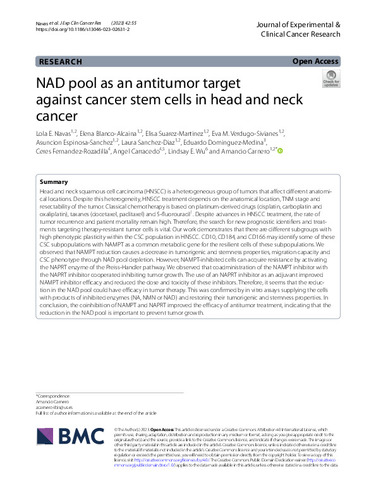
NAD pool as an antitumor target against cancer stem cells in head and neck cancer

Author:
Navas, Lola Eufemia; Blanco Alcaina, Elena; Suárez Martínez, Elisa; Verdugo Sivianes, Eva Mª; Espinosa Sánchez, Asunción; [et al.]
URI:
https://hdl.handle.net/20.500.12412/7090
ISSN:
1756-9966
DOI:
10.1186/s13046-023-02631-2
Date:
2023-03-03
Abstract:

Head and neck squamous cell carcinoma (HNSCC) is a heterogeneous group of tumors that affect different anatomical locations. Despite this heterogeneity, HNSCC treatment depends on the anatomical location, TNM stage and resectability of the tumor. Classical chemotherapy is based on platinum-derived drugs (cisplatin, carboplatin and oxaliplatin), taxanes (docetaxel, paclitaxel) and 5-fluorouracil1. Despite advances in HNSCC treatment, the rate of tumor recurrence and patient mortality remain high. Therefore, the search for new prognostic identifiers and treatments targeting therapy-resistant tumor cells is vital. Our work demonstrates that there are different subgroups with high phenotypic plasticity within the CSC population in HNSCC. CD10, CD184, and CD166 may identify some of these CSC subpopulations with NAMPT as a common metabolic gene for the resilient cells of these subpopulations. We observed that NAMPT reduction causes a decrease in tumorigenic and stemness properties, migration capacity and CSC phenotype through NAD pool depletion. However, NAMPT-inhibited cells can acquire resistance by activating the NAPRT enzyme of the Preiss-Handler pathway. We observed that coadministration of the NAMPT inhibitor with the NAPRT inhibitor cooperated inhibiting tumor growth. The use of an NAPRT inhibitor as an adjuvant improved NAMPT inhibitor efficacy and reduced the dose and toxicity of these inhibitors. Therefore, it seems that the reduction in the NAD pool could have efficacy in tumor therapy. This was confirmed by in vitro assays supplying the cells with products of inhibited enzymes (NA, NMN or NAD) and restoring their tumorigenic and stemness properties. In conclusion, the coinhibition of NAMPT and NAPRT improved the efficacy of antitumor treatment, indicating that the reduction in the NAD pool is important to prevent tumor growth.

Head and neck squamous cell carcinoma (HNSCC) is a heterogeneous group of tumors that affect different anatomical locations. Despite this heterogeneity, HNSCC treatment depends on the anatomical location, TNM stage and resectability of the tumor. Classical chemotherapy is based on platinum-derived drugs (cisplatin, carboplatin and oxaliplatin), taxanes (docetaxel, paclitaxel) and 5-fluorouracil1. Despite advances in HNSCC treatment, the rate of tumor recurrence and patient mortality remain high. Therefore, the search for new prognostic identifiers and treatments targeting therapy-resistant tumor cells is vital. Our work demonstrates that there are different subgroups with high phenotypic plasticity within the CSC population in HNSCC. CD10, CD184, and CD166 may identify some of these CSC subpopulations with NAMPT as a common metabolic gene for the resilient cells of these subpopulations. We observed that NAMPT reduction causes a decrease in tumorigenic and stemness properties, migration capacity and CSC phenotype through NAD pool depletion. However, NAMPT-inhibited cells can acquire resistance by activating the NAPRT enzyme of the Preiss-Handler pathway. We observed that coadministration of the NAMPT inhibitor with the NAPRT inhibitor cooperated inhibiting tumor growth. The use of an NAPRT inhibitor as an adjuvant improved NAMPT inhibitor efficacy and reduced the dose and toxicity of these inhibitors. Therefore, it seems that the reduction in the NAD pool could have efficacy in tumor therapy. This was confirmed by in vitro assays supplying the cells with products of inhibited enzymes (NA, NMN or NAD) and restoring their tumorigenic and stemness properties. In conclusion, the coinhibition of NAMPT and NAPRT improved the efficacy of antitumor treatment, indicating that the reduction in the NAD pool is important to prevent tumor growth.

Show full item record
Collections
  • Artículos
Files in this item
Thumbnail
Artículo principal (7.941Mb)
Share
Export to Mendeley
Statistics
Usage statistics
Metrics and citations  
Go to Brújula home

Universidad Loyola

Library

Contact

Facebook Loyola BibliotecaTwitter Loyola Biblioteca

The content of the Repository is protected with a Creative Commons license:

Attribution-NonCommercial-NoDerivatives 4.0 Internacional

Creative Commons Image