Brújula Home

Institutional repository of the Universidad Loyola

View Item 
  •   Brújula Home
  • PRODUCCIÓN CIENTÍFICA Y TRANSFERENCIA
  • Departamento Comunicación y Educación
  • Artículos
  • View Item
  •   Brújula Home
  • PRODUCCIÓN CIENTÍFICA Y TRANSFERENCIA
  • Departamento Comunicación y Educación
  • Artículos
  • View Item
    • español
    • English
JavaScript is disabled for your browser. Some features of this site may not work without it.

Browse

All of BrújulaCommunities and CollectionsAuthorsTitlesKeywordsAuthor profilesThis CollectionAuthorsTitlesKeywords

My Account

Login

Statistics

View Usage Statistics

Añadido Recientemente

Novedades
Repository
How to publish
Visibility
FAQs

Effects of strength training and detraining considering maturity status in youth highly trained basketball players

Author:
Gonzalo-Skok, Oliver; Arede, Jorge; Dos'Santos, Thomas
URI:
https://hdl.handle.net/20.500.12412/7105
ISSN:
1932-6203
DOI:
10.1371/journal.pone.0317879
Date:
2025-02
Abstract:

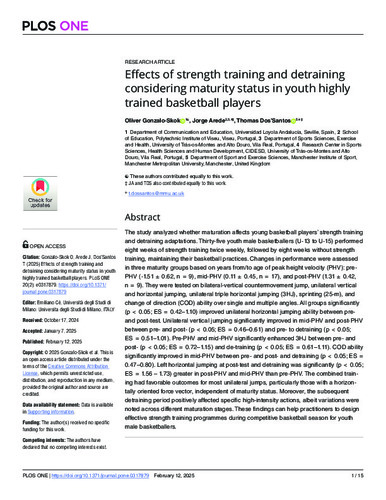
The study analyzed whether maturation affects young basketball players' strength training and detraining adaptations. Thirty-five youth male basketballers (U-13 to U-15) performed eight weeks of strength training twice weekly, followed by eight weeks without strength training, maintaining their basketball practices. Changes in performance were assessed in three maturity groups based on years from/to age of peak height velocity (PHV): pre-PHV (-1.51 +/- 0.62, n = 9), mid-PHV (0.11 +/- 0.45, n = 17), and post-PHV (1.31 +/- 0.42, n = 9). They were tested on bilateral-vertical countermovement jump, unilateral vertical and horizontal jumping, unilateral triple horizontal jumping (3HJ), sprinting (25-m), and change of direction (COD) ability over single and multiple angles. All groups significantly (p < 0.05; ES = 0.42-1.10) improved unilateral horizontal jumping ability between pre-and post-test. Unilateral vertical jumping significantly improved in mid-PHV and post-PHV between pre- and post- (p < 0.05; ES = 0.46-0.61) and pre- to detraining (p < 0.05; ES = 0.51-1.01). Pre-PHV and mid-PHV significantly enhanced 3HJ between pre- and post- (p < 0.05; ES = 0.72-1.15) and de-training (p < 0.05; ES = 0.61-1.11). COD ability significantly improved in mid-PHV between pre- and post- and detraining (p < 0.05; ES = 0.47-0.80). Left horizontal jumping at post-test and detraining was significantly (p < 0.05; ES = 1.56 - 1.73) greater in post-PHV and mid-PHV than pre-PHV. The combined training had favorable outcomes for most unilateral jumps, particularly those with a horizontally oriented force vector, independent of maturity status. Moreover, the subsequent detraining period positively affected specific high-intensity actions, albeit variations were noted across different maturation stages. These findings can help practitioners to design effective strength training programmes during competitive basketball season for youth male basketballers.

The study analyzed whether maturation affects young basketball players' strength training and detraining adaptations. Thirty-five youth male basketballers (U-13 to U-15) performed eight weeks of strength training twice weekly, followed by eight weeks without strength training, maintaining their basketball practices. Changes in performance were assessed in three maturity groups based on years from/to age of peak height velocity (PHV): pre-PHV (-1.51 +/- 0.62, n = 9), mid-PHV (0.11 +/- 0.45, n = 17), and post-PHV (1.31 +/- 0.42, n = 9). They were tested on bilateral-vertical countermovement jump, unilateral vertical and horizontal jumping, unilateral triple horizontal jumping (3HJ), sprinting (25-m), and change of direction (COD) ability over single and multiple angles. All groups significantly (p < 0.05; ES = 0.42-1.10) improved unilateral horizontal jumping ability between pre-and post-test. Unilateral vertical jumping significantly improved in mid-PHV and post-PHV between pre- and post- (p < 0.05; ES = 0.46-0.61) and pre- to detraining (p < 0.05; ES = 0.51-1.01). Pre-PHV and mid-PHV significantly enhanced 3HJ between pre- and post- (p < 0.05; ES = 0.72-1.15) and de-training (p < 0.05; ES = 0.61-1.11). COD ability significantly improved in mid-PHV between pre- and post- and detraining (p < 0.05; ES = 0.47-0.80). Left horizontal jumping at post-test and detraining was significantly (p < 0.05; ES = 1.56 - 1.73) greater in post-PHV and mid-PHV than pre-PHV. The combined training had favorable outcomes for most unilateral jumps, particularly those with a horizontally oriented force vector, independent of maturity status. Moreover, the subsequent detraining period positively affected specific high-intensity actions, albeit variations were noted across different maturation stages. These findings can help practitioners to design effective strength training programmes during competitive basketball season for youth male basketballers.

Show full item record
Collections
  • Artículos
Files in this item
Thumbnail
Effects_of_strength_training_and_detraining_consid.pdf (652.2Kb)
Share
Export to Mendeley
Statistics
Usage statistics
Metrics and citations  
Go to Brújula home

Universidad Loyola

Library

Contact

Facebook Loyola BibliotecaTwitter Loyola Biblioteca

The content of the Repository is protected with a Creative Commons license:

Attribution-NonCommercial-NoDerivatives 4.0 Internacional

Creative Commons Image