Brújula Home

Institutional repository of the Universidad Loyola

View Item 
  •   Brújula Home
  • PRODUCCIÓN CIENTÍFICA Y TRANSFERENCIA
  • Departamento de Salud
  • Artículos
  • View Item
  •   Brújula Home
  • PRODUCCIÓN CIENTÍFICA Y TRANSFERENCIA
  • Departamento de Salud
  • Artículos
  • View Item
    • español
    • English
JavaScript is disabled for your browser. Some features of this site may not work without it.

Browse

All of BrújulaCommunities and CollectionsAuthorsTitlesKeywordsAuthor profilesThis CollectionAuthorsTitlesKeywords

My Account

Login

Statistics

View Usage Statistics

Añadido Recientemente

Novedades
Repository
How to publish
Visibility
FAQs

Inferring inter-phylum gene transfer events from unique genes detected in Parageobacillus thermoglucosidasius

Author:
Cuecas, Alba; Delgado, José Antonio; González, Juan Miguel
URI:
https://hdl.handle.net/20.500.12412/7111
ISSN:
1055-7903
DOI:
10.1016/j.ympev.2025.108329
Date:
2025-03-19
Keyword(s):

Horizontal gene transfer

Pan-genome

Parageobacillus thermoglucosidasius

Microbial evolution

Microbial adaptation

Abstract:

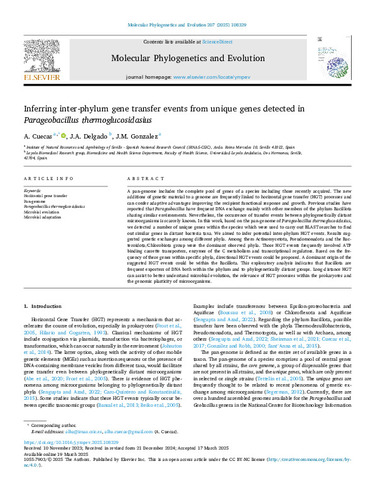
A pan-genome includes the complete pool of genes of a species including those recently acquired. The new additions of genetic material to a genome are frequently linked to horizontal gene transfer (HGT) processes and can confer adaptive advantages improving the recipient functional response and growth. Previous studies have reported that Parageobacillus have frequent DNA exchange mainly with other members of the phylum Bacillota sharing similar environments. Nevertheless, the occurrence of transfer events between phylogenetically distant microorganisms is scarcely known. In this work, based on the pan-genome of Parageobacillus thermoglucosidasius, we detected a number of unique genes within the species which were used to carry out BLAST searches to find out similar genes in distant bacteria taxa. We aimed to infer potential inter-phylum HGT events. Results suggested genetic exchanges among different phyla. Among them Actinomycetota, Pseudomonadota and the Bacteroidota/ Chlorobiota group were the dominant observed phyla. Those HGT events frequently involved ATP binding cassette transporters, enzymes of the C metabolism and transcriptional regulators. Based on the frequency of these genes within specific phyla, directional HGT events could be proposed. A dominant origin of the suggested HGT events could be within the Bacillota. This exploratory analysis indicates that Bacillota are frequent exporters of DNA both within the phylum and to phylogenetically distant groups. Long-distance HGT can assist to better understand microbial evolution, the relevance of HGT processes within the prokaryotes and the genomic plasticity of microorganisms.

A pan-genome includes the complete pool of genes of a species including those recently acquired. The new additions of genetic material to a genome are frequently linked to horizontal gene transfer (HGT) processes and can confer adaptive advantages improving the recipient functional response and growth. Previous studies have reported that Parageobacillus have frequent DNA exchange mainly with other members of the phylum Bacillota sharing similar environments. Nevertheless, the occurrence of transfer events between phylogenetically distant microorganisms is scarcely known. In this work, based on the pan-genome of Parageobacillus thermoglucosidasius, we detected a number of unique genes within the species which were used to carry out BLAST searches to find out similar genes in distant bacteria taxa. We aimed to infer potential inter-phylum HGT events. Results suggested genetic exchanges among different phyla. Among them Actinomycetota, Pseudomonadota and the Bacteroidota/ Chlorobiota group were the dominant observed phyla. Those HGT events frequently involved ATP binding cassette transporters, enzymes of the C metabolism and transcriptional regulators. Based on the frequency of these genes within specific phyla, directional HGT events could be proposed. A dominant origin of the suggested HGT events could be within the Bacillota. This exploratory analysis indicates that Bacillota are frequent exporters of DNA both within the phylum and to phylogenetically distant groups. Long-distance HGT can assist to better understand microbial evolution, the relevance of HGT processes within the prokaryotes and the genomic plasticity of microorganisms.

Show full item record
Collections
  • Artículos
Files in this item
Thumbnail
Articulo_2025_1.pdf (5.924Mb)
Share
Export to Mendeley
Statistics
Usage statistics
Metrics and citations  
Go to Brújula home

Universidad Loyola

Library

Contact

Facebook Loyola BibliotecaTwitter Loyola Biblioteca

The content of the Repository is protected with a Creative Commons license:

Attribution-NonCommercial-NoDerivatives 4.0 Internacional

Creative Commons Image