Brújula Home

Institutional repository of the Universidad Loyola

View Item 
  •   Brújula Home
  • PRODUCCIÓN CIENTÍFICA Y TRANSFERENCIA
  • Departamento Gestión Empresarial
  • Artículos
  • View Item
  •   Brújula Home
  • PRODUCCIÓN CIENTÍFICA Y TRANSFERENCIA
  • Departamento Gestión Empresarial
  • Artículos
  • View Item
    • español
    • English
JavaScript is disabled for your browser. Some features of this site may not work without it.

Browse

All of BrújulaCommunities and CollectionsAuthorsTitlesKeywordsAuthor profilesThis CollectionAuthorsTitlesKeywords

My Account

Login

Statistics

View Usage Statistics

Añadido Recientemente

Novedades
Repository
How to publish
Visibility
FAQs

The use of continuous visual aid in the Best–Worst Method: an experiment with organic farmers in Paraguay

Author:
Fernández‑Portillo, Luis A.; Estepa-Mohedano, Lorenzo; Demir, Gülay
URI:
https://hdl.handle.net/20.500.12412/7114
ISSN:
1387-585X
DOI:
10.1007/s10668-024-04648-9
Date:
2024-03
Keyword(s):

Rural development

Organic agriculture

Multi-criteria decision analysis (MCDA)

Best–Worst Method (BWM)

Continuous visual aid (slider)

Developing country

Abstract:

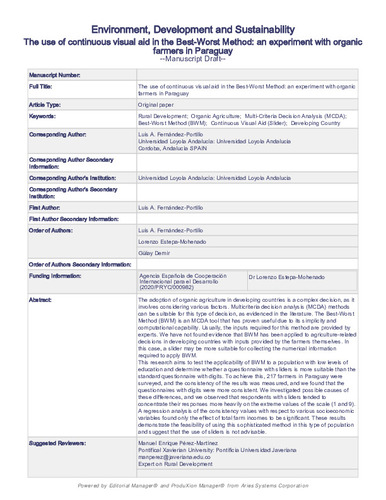
The adoption of organic agriculture in developing countries is a complex decision, as it involves considering various factors. Multicriteria decision analysis (MCDA) methods can be suitable for this type of decision, as evidenced in the literature. The Best–Worst Method (BWM) is an MCDA tool that has proven useful due to its simplicity and computational capability. This research aims to test the applicability of this method to a population with low levels of education and determine whether a questionnaire with a continuous visual aid, a slider, is more suitable than the standard questionnaire with digits. Moreover, it aims to ascertain which factors the consistency of the responses depends on. To achieve this,217 farmers in Paraguay were surveyed, and the consistency of the results was measured. We found that the questionnaires with digits were more consistent. Then we investigated possible causes of these differences, observing that respondents with sliders tended to concentrate their responses more heavily on the extreme values of the scale (1 and 9). A regression analysis of the consistency values with respect to various socioeconomic variables found only a slight effect of total farm incomes to be significant. These results demonstrate the feasibility of using this sophisticated method in this type of population and suggest that using sliders is not advisable.

The adoption of organic agriculture in developing countries is a complex decision, as it involves considering various factors. Multicriteria decision analysis (MCDA) methods can be suitable for this type of decision, as evidenced in the literature. The Best–Worst Method (BWM) is an MCDA tool that has proven useful due to its simplicity and computational capability. This research aims to test the applicability of this method to a population with low levels of education and determine whether a questionnaire with a continuous visual aid, a slider, is more suitable than the standard questionnaire with digits. Moreover, it aims to ascertain which factors the consistency of the responses depends on. To achieve this,217 farmers in Paraguay were surveyed, and the consistency of the results was measured. We found that the questionnaires with digits were more consistent. Then we investigated possible causes of these differences, observing that respondents with sliders tended to concentrate their responses more heavily on the extreme values of the scale (1 and 9). A regression analysis of the consistency values with respect to various socioeconomic variables found only a slight effect of total farm incomes to be significant. These results demonstrate the feasibility of using this sophisticated method in this type of population and suggest that using sliders is not advisable.


Es la versión aceptada del documento. Se puede consultar la versión final en https://doi.org/10.1007/s10668-024-04648-9

Es la versión aceptada del documento. Se puede consultar la versión final en https://doi.org/10.1007/s10668-024-04648-9

 
Show full item record
Collections
  • Artículos
Files in this item
Thumbnail
ENVI-S-23-05776.pdf (2.018Mb)
Share
Export to Mendeley
Statistics
Usage statistics
Metrics and citations  
Go to Brújula home

Universidad Loyola

Library

Contact

Facebook Loyola BibliotecaTwitter Loyola Biblioteca

The content of the Repository is protected with a Creative Commons license:

Attribution-NonCommercial-NoDerivatives 4.0 Internacional

Creative Commons Image