Brújula Home

Institutional repository of the Universidad Loyola

View Item 
  •   Brújula Home
  • PRODUCCIÓN CIENTÍFICA Y TRANSFERENCIA
  • Departamento Ingeniería
  • Artículos
  • View Item
  •   Brújula Home
  • PRODUCCIÓN CIENTÍFICA Y TRANSFERENCIA
  • Departamento Ingeniería
  • Artículos
  • View Item
    • español
    • English
JavaScript is disabled for your browser. Some features of this site may not work without it.

Browse

All of BrújulaCommunities and CollectionsAuthorsTitlesKeywordsAuthor profilesThis CollectionAuthorsTitlesKeywords

My Account

Login

Statistics

View Usage Statistics

Añadido Recientemente

Novedades
Repository
How to publish
Visibility
FAQs

Using simple estimates for the flexural stiffness of thick FDM beams based on sandwich beam models

Author:
Dominguez Abascal, Jaime; Millan Gata, Pablo; García Vallejo, Daniel; Tapia Córdoba, Alejandro
URI:
https://hdl.handle.net/20.500.12412/7142
ISSN:
1355-2546
DOI:
10.1108/RPJ-05-2019-0124
Date:
2024
Keyword(s):

Fused deposition modeling

Model

Characterization

Sandwich structures

Flexural behavior

Abstract:

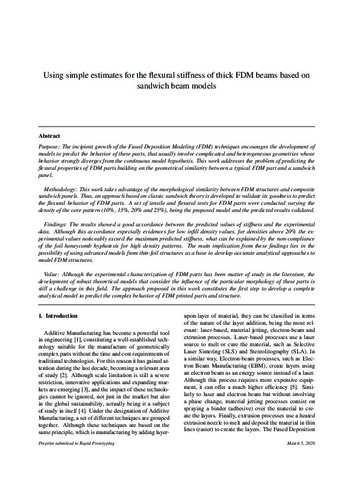
Purpose: The incipient growth of the Fused Deposition Modeling (FDM) techniques encourages the development of models to predict the behavior of these parts, that usually involve complicated and heterogeneous geometries whose behavior strongly diverges from the continuous model hypothesis. This work addresses the problem of predicting the flexural properties of FDM parts building on the geometrical similarity between a typical FDM part and a sandwich panel. Methodology: This work takes advantage of the morphological similarity between FDM structures and composite sandwich panels. Thus, an approach based on classic sandwich theory is developed to validate its goodness to predict the flexural behavior of FDM parts. A set of tensile and flexural tests for FDM parts were conducted varying the density of the core pattern (10%, 15%, 20% and 25%), being the proposed model and the predicted results validated. Findings: The results showed a good accordance between the predicted values of stiffness and the experimental data. Although this accordance especially evidences for low infill density values, for densities above 20% the experimental values noticeably exceed the maximum predicted stiffness, what can be explained by the non-compliance of the foil honeycomb hyphotesis for high density patterns. The main implication from these findings lies in the possibility of using advanced models from thin-foil structures as a base to develop accurate analytical approaches to model FDM structures. Value: Although the experimental characterization of FDM parts has been matter of study in the literature, the development of robust theoretical models that consider the influence of the particular morphology of these parts is still a challenge in this field. The approach proposed in this work constitutes the first step to develop a complete analytical model to predict the complex behavior of FDM printed parts and structure.

Purpose: The incipient growth of the Fused Deposition Modeling (FDM) techniques encourages the development of models to predict the behavior of these parts, that usually involve complicated and heterogeneous geometries whose behavior strongly diverges from the continuous model hypothesis. This work addresses the problem of predicting the flexural properties of FDM parts building on the geometrical similarity between a typical FDM part and a sandwich panel. Methodology: This work takes advantage of the morphological similarity between FDM structures and composite sandwich panels. Thus, an approach based on classic sandwich theory is developed to validate its goodness to predict the flexural behavior of FDM parts. A set of tensile and flexural tests for FDM parts were conducted varying the density of the core pattern (10%, 15%, 20% and 25%), being the proposed model and the predicted results validated. Findings: The results showed a good accordance between the predicted values of stiffness and the experimental data. Although this accordance especially evidences for low infill density values, for densities above 20% the experimental values noticeably exceed the maximum predicted stiffness, what can be explained by the non-compliance of the foil honeycomb hyphotesis for high density patterns. The main implication from these findings lies in the possibility of using advanced models from thin-foil structures as a base to develop accurate analytical approaches to model FDM structures. Value: Although the experimental characterization of FDM parts has been matter of study in the literature, the development of robust theoretical models that consider the influence of the particular morphology of these parts is still a challenge in this field. The approach proposed in this work constitutes the first step to develop a complete analytical model to predict the complex behavior of FDM printed parts and structure.


Es la versión preprint del artículo. Se puede consultar la versión final en https://doi.org/10.1108/RPJ-05-2019-0124

Es la versión preprint del artículo. Se puede consultar la versión final en https://doi.org/10.1108/RPJ-05-2019-0124

 
Show full item record
Collections
  • Artículos
Files in this item
Thumbnail
Artículo__RPJ____Using_simple_estimates_for_the_flexural_stiffness_of_thick_FDM.pdf (1.644Mb)
Share
Export to Mendeley
Statistics
Usage statistics
Metrics and citations  
Go to Brújula home

Universidad Loyola

Library

Contact

Facebook Loyola BibliotecaTwitter Loyola Biblioteca

The content of the Repository is protected with a Creative Commons license:

Attribution-NonCommercial-NoDerivatives 4.0 Internacional

Creative Commons Image