Brújula Home

Institutional repository of the Universidad Loyola

View Item 
  •   Brújula Home
  • PRODUCCIÓN CIENTÍFICA Y TRANSFERENCIA
  • Departamento Comunicación y Educación
  • Artículos
  • View Item
  •   Brújula Home
  • PRODUCCIÓN CIENTÍFICA Y TRANSFERENCIA
  • Departamento Comunicación y Educación
  • Artículos
  • View Item
    • español
    • English
JavaScript is disabled for your browser. Some features of this site may not work without it.

Browse

All of BrújulaCommunities and CollectionsAuthorsTitlesKeywordsAuthor profilesThis CollectionAuthorsTitlesKeywords

My Account

Login

Statistics

View Usage Statistics

Añadido Recientemente

Novedades
Repository
How to publish
Visibility
FAQs

Contextual factors affect match sprinting demands and effective playing time in Spanish professional football

Author:
Galiano, Carlos; Gómez-Piqueras, Pedro; Piernas, Alberto; Gonzalo-Skok, Oliver
URI:
https://hdl.handle.net/20.500.12412/7191
ISSN:
0860-021X
DOI:
10.5114/biolsport.2026.159571
Date:
2026-04-13
Keyword(s):

Number of sprints

Effective playing time

Match location

Final score

Match difficulty

Sprint distance

Professional football

Abstract:

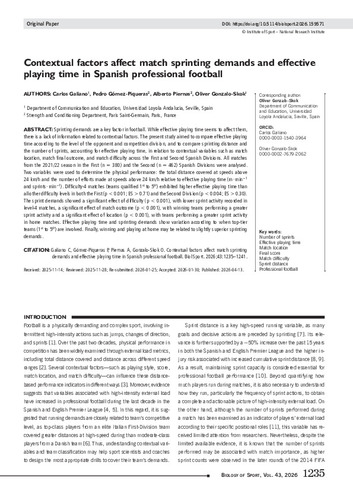
Sprinting demands are a key factor in football. While effective playing time seems to affect them, there is a lack of information related to contextual factors. The present study aimed to compare effective playing time according to the level of the opponent and competition division, and to compare sprinting distance and the number of sprints, accounting for effective playing time, in relation to contextual variables such as match location, match final outcome, and match difficulty across the First and Second Spanish Divisions. All matches from the 2021/22 season in the First (n = 380) and the Second (n = 462) Spanish Divisions were analysed. Two variables were used to determine the physical performance: the total distance covered at speeds above 24 km/h and the number of efforts made at speeds above 24 km/h relative to effective playing time (m · min−1 and sprints · min−1). Difficulty-4 matches (teams qualified 1st to 5th) exhibited higher effective playing time than all other difficulty levels in both the First (p < 0.001; ES > 0.71) and the Second Division (p < 0.004; ES > 0.30). The sprint demands showed a significant effect of difficulty (p < 0.001), with lower sprint activity recorded in level-4 matches, a significant effect of match outcome (p < 0.001), with winning teams performing a greater sprint activity and a significant effect of location (p < 0.001), with teams performing a greater sprint activity in home matches. Effective playing time and sprinting demands show variation according to when top-tier teams (1st to 5th) are involved. Finally, winning and playing at home may be related to slightly superior sprinting demands.

Sprinting demands are a key factor in football. While effective playing time seems to affect them, there is a lack of information related to contextual factors. The present study aimed to compare effective playing time according to the level of the opponent and competition division, and to compare sprinting distance and the number of sprints, accounting for effective playing time, in relation to contextual variables such as match location, match final outcome, and match difficulty across the First and Second Spanish Divisions. All matches from the 2021/22 season in the First (n = 380) and the Second (n = 462) Spanish Divisions were analysed. Two variables were used to determine the physical performance: the total distance covered at speeds above 24 km/h and the number of efforts made at speeds above 24 km/h relative to effective playing time (m · min−1 and sprints · min−1). Difficulty-4 matches (teams qualified 1st to 5th) exhibited higher effective playing time than all other difficulty levels in both the First (p < 0.001; ES > 0.71) and the Second Division (p < 0.004; ES > 0.30). The sprint demands showed a significant effect of difficulty (p < 0.001), with lower sprint activity recorded in level-4 matches, a significant effect of match outcome (p < 0.001), with winning teams performing a greater sprint activity and a significant effect of location (p < 0.001), with teams performing a greater sprint activity in home matches. Effective playing time and sprinting demands show variation according to when top-tier teams (1st to 5th) are involved. Finally, winning and playing at home may be related to slightly superior sprinting demands.

Show full item record
Collections
  • Artículos
Files in this item
Thumbnail
BS_Art_57610-10.pdf (326.4Kb)
Share
Export to Mendeley
Statistics
Usage statistics
Metrics and citations  
Go to Brújula home

Universidad Loyola

Library

Contact

Facebook Loyola BibliotecaTwitter Loyola Biblioteca

The content of the Repository is protected with a Creative Commons license:

Attribution-NonCommercial-NoDerivatives 4.0 Internacional

Creative Commons Image