Brújula Home

Institutional repository of the Universidad Loyola

View Item 
  •   Brújula Home
  • PRODUCCIÓN CIENTÍFICA Y TRANSFERENCIA
  • Departamento Psicología
  • Artículos
  • View Item
  •   Brújula Home
  • PRODUCCIÓN CIENTÍFICA Y TRANSFERENCIA
  • Departamento Psicología
  • Artículos
  • View Item
    • español
    • English
JavaScript is disabled for your browser. Some features of this site may not work without it.

Browse

All of BrújulaCommunities and CollectionsAuthorsTitlesKeywordsAuthor profilesThis CollectionAuthorsTitlesKeywords

My Account

Login

Statistics

View Usage Statistics

Añadido Recientemente

Novedades
Repository
How to publish
Visibility
FAQs

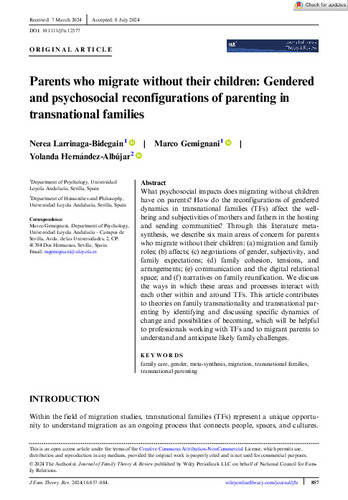
Parents who migrate without their children: Gendered and psychosocial reconfigurations of parenting in transnational families

Author:
Larrinaga-Bidegain, Nerea; Gemignani, MarcoUniversidad Loyola Authority; Hernández-Albújar, YolandaUniversidad Loyola Authority
URI:
https://hdl.handle.net/20.500.12412/7242
ISSN:
1756-2570
DOI:
10.1111/jftr.12577
Date:
2024-07-23
Keyword(s):

Family care

Gender

Meta-synthesis

Migration

Transnational families

Transnational parenting

Abstract:

What psychosocial impacts does migrating without children have on parents? How do the reconfigurations of gendered dynamics in transnational families (TFs) affect the well-being and subjectivities of mothers and fathers in the hosting and sending communities? Through this literature meta-synthesis, we describe six main areas of concern for parents who migrate without their children: (a) migration and family roles; (b) affects; (c) negotiations of gender, subjectivity, and family expectations; (d) family cohesion, tensions, and arrangements; (e) communication and the digital relational space; and (f) narratives on family reunification. We discuss the ways in which these areas and processes interact with each other within and around TFs. This article contributes to theories on family transnationality and transnational parenting by identifying and discussing specific dynamics of change and possibilities of becoming, which will be helpful to professionals working with TFs and to migrant parents to understand and anticipate likely family challenges.

What psychosocial impacts does migrating without children have on parents? How do the reconfigurations of gendered dynamics in transnational families (TFs) affect the well-being and subjectivities of mothers and fathers in the hosting and sending communities? Through this literature meta-synthesis, we describe six main areas of concern for parents who migrate without their children: (a) migration and family roles; (b) affects; (c) negotiations of gender, subjectivity, and family expectations; (d) family cohesion, tensions, and arrangements; (e) communication and the digital relational space; and (f) narratives on family reunification. We discuss the ways in which these areas and processes interact with each other within and around TFs. This article contributes to theories on family transnationality and transnational parenting by identifying and discussing specific dynamics of change and possibilities of becoming, which will be helpful to professionals working with TFs and to migrant parents to understand and anticipate likely family challenges.

Show full item record
Collections
  • Artículos
Files in this item
Thumbnail
J of Family TheoRevie - 2024 - Larrinaga‐Bidegain - Parents who migrate without their children.pdf (1.092Mb)
Share
Export to Mendeley
Statistics
Usage statistics
Metrics and citations  
Go to Brújula home

Universidad Loyola

Library

Contact

Facebook Loyola BibliotecaTwitter Loyola Biblioteca

The content of the Repository is protected with a Creative Commons license:

Attribution-NonCommercial-NoDerivatives 4.0 Internacional

Creative Commons Image