Brújula Home

Institutional repository of the Universidad Loyola

View Item 
  •   Brújula Home
  • PRODUCCIÓN CIENTÍFICA Y TRANSFERENCIA
  • Departamento Psicología
  • Artículos
  • View Item
  •   Brújula Home
  • PRODUCCIÓN CIENTÍFICA Y TRANSFERENCIA
  • Departamento Psicología
  • Artículos
  • View Item
    • español
    • English
JavaScript is disabled for your browser. Some features of this site may not work without it.

Browse

All of BrújulaCommunities and CollectionsAuthorsTitlesKeywordsAuthor profilesThis CollectionAuthorsTitlesKeywords

My Account

Login

Statistics

View Usage Statistics

Añadido Recientemente

Novedades
Repository
How to publish
Visibility
FAQs

The impact of childhood cancer on sexual identity development: the CISEO (Cancer-Induced Sexual Exploration Obstacles) model

Author:
Terlinden, Victoire; Aires-González, María-del-Mar; Gemignani, MarcoUniversidad Loyola Authority; Cano-García, Francisco-Javier
URI:
https://hdl.handle.net/20.500.12412/7248
ISSN:
1743-6095
DOI:
10.1093/jsxmed/qdag087
Date:
2026-04-16
Keyword(s):

Childhood cancer survivors

Sexual identity

Cancer survivorship care

Psychosexual

Sexual exploration

Abstract:

Young Adult Childhood Cancer Survivors (YACCS) often face significant challenges to their psychosexual development, including body image issues, later sexual debut, and worse sexual functioning and/or satisfaction.1 While physical consequences are well-studied, emotional and developmental impacts on sexuality—defined here as the broader constructions of sexualidentity andpractice—remainunder-examined. Sexual identity development, i.e., the process of defining oneself as a sexual being, is a critical adolescent milestone which relies on two essential components: exploration and commitment.2 Life-threatening trauma, such as childhood cancer (CC), can profoundly disrupt this process by creating barriers that complicate identity development and integration. Survivors struggle to integrate their pre-cancer and postcancer selves, potentially leading to maladaptive identity formation (eg, identity diffusion or foreclosure).3 Since YACCS consistently report unmet sexual health needs,4 identifying the psychosocial drivers of these challenges is essential t o improve routine clinical interventions.
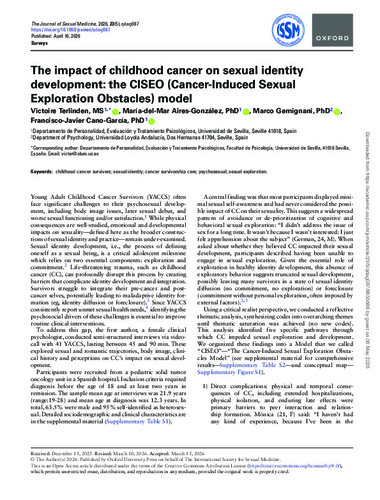
Young Adult Childhood Cancer Survivors (YACCS) often face significant challenges to their psychosexual development, including body image issues, later sexual debut, and worse sexual functioning and/or satisfaction.1 While physical consequences are well-studied, emotional and developmental impacts on sexuality—defined here as the broader constructions of sexualidentity andpractice—remainunder-examined. Sexual identity development, i.e., the process of defining oneself as a sexual being, is a critical adolescent milestone which relies on two essential components: exploration and commitment.2 Life-threatening trauma, such as childhood cancer (CC), can profoundly disrupt this process by creating barriers that complicate identity development and integration. Survivors struggle to integrate their pre-cancer and postcancer selves, potentially leading to maladaptive identity formation (eg, identity diffusion or foreclosure).3 Since YACCS consistently report unmet sexual health needs,4 identifying the psychosocial drivers of these challenges is essential t o improve routine clinical interventions.

Show full item record
Collections
  • Artículos
Files in this item
Thumbnail
qdag087.pdf (257.5Kb)
Share
Export to Mendeley
Statistics
Usage statistics
Metrics and citations  
Go to Brújula home

Universidad Loyola

Library

Contact

Facebook Loyola BibliotecaTwitter Loyola Biblioteca

The content of the Repository is protected with a Creative Commons license:

Attribution-NonCommercial-NoDerivatives 4.0 Internacional

Creative Commons Image