Brújula Home

Institutional repository of the Universidad Loyola

View Item 
  •   Brújula Home
  • PRODUCCIÓN CIENTÍFICA Y TRANSFERENCIA
  • Departamento Psicología
  • Artículos
  • View Item
  •   Brújula Home
  • PRODUCCIÓN CIENTÍFICA Y TRANSFERENCIA
  • Departamento Psicología
  • Artículos
  • View Item
    • español
    • English
JavaScript is disabled for your browser. Some features of this site may not work without it.

Browse

All of BrújulaCommunities and CollectionsAuthorsTitlesKeywordsAuthor profilesThis CollectionAuthorsTitlesKeywords

My Account

Login

Statistics

View Usage Statistics

Añadido Recientemente

Novedades
Repository
How to publish
Visibility
FAQs

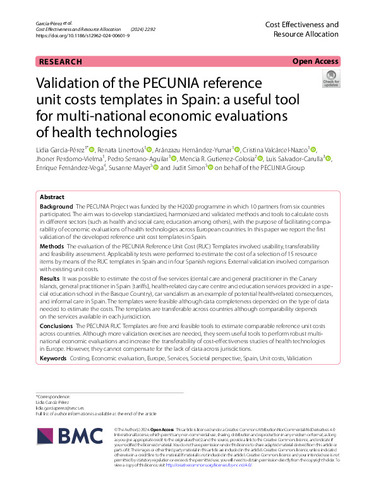
Validation of the PECUNIA Reference Unit Costs templates in Spain: a useful tool for multi-national economic evaluations of health technologies

Author:
García Pérez, Lidia; Linertová, Renata; Hernández Yumar, Aránzazu; Valcárcel Nazco, Cristina; Perdomo Vielma, Jhoner; [et al.]
URI:
https://hdl.handle.net/20.500.12412/7391
ISSN:
1478-7547
DOI:
10.1186/s12962-024-00601-9
Date:
2024-12-18
Keyword(s):

Costing; Economic evaluation; Europe; Services; Societal perspective; Spain; Unit costs; Validation

Abstract:

Background The PECUNIA Project was funded by the H2020 programme in which 10 partners from six countries participated. The aim was to develop standardized, harmonized and validated methods and tools to calculate costs in different sectors (such as health and social care, education among others), with the purpose of facilitating comparability of economic evaluations of health technologies across European countries. In this paper we report the first validation of the developed reference unit cost templates in Spain. Methods The evaluation of the PECUNIA Reference Unit Cost (RUC) Templates involved usability, transferability and feasibility assessment. Applicability tests were performed to estimate the cost of a selection of 15 resource items by means of the RUC templates in Spain and in four Spanish regions. External validation involved comparison with existing unit costs. Results It was possible to estimate the cost of five services (dental care and general practitioner in the Canary Islands, general practitioner in Spain [tariffs], health-related day care centre and education services provided in a special education school in the Basque Country), car vandalism as an example of potential health-related consequences, and informal care in Spain. The templates were feasible although data completeness depended on the type of data needed to estimate the costs. The templates are transferable across countries although comparability depends on the services available in each jurisdiction. Conclusions The PECUNIA RUC Templates are free and feasible tools to estimate comparable reference unit costs across countries. Although more validation exercises are needed, they seem useful tools to perform robust multi-national economic evaluations and increase the transferability of cost-effectiveness studies of health technologies in Europe. However, they cannot compensate for the lack of data across jurisdictions.

Background The PECUNIA Project was funded by the H2020 programme in which 10 partners from six countries participated. The aim was to develop standardized, harmonized and validated methods and tools to calculate costs in different sectors (such as health and social care, education among others), with the purpose of facilitating comparability of economic evaluations of health technologies across European countries. In this paper we report the first validation of the developed reference unit cost templates in Spain. Methods The evaluation of the PECUNIA Reference Unit Cost (RUC) Templates involved usability, transferability and feasibility assessment. Applicability tests were performed to estimate the cost of a selection of 15 resource items by means of the RUC templates in Spain and in four Spanish regions. External validation involved comparison with existing unit costs. Results It was possible to estimate the cost of five services (dental care and general practitioner in the Canary Islands, general practitioner in Spain [tariffs], health-related day care centre and education services provided in a special education school in the Basque Country), car vandalism as an example of potential health-related consequences, and informal care in Spain. The templates were feasible although data completeness depended on the type of data needed to estimate the costs. The templates are transferable across countries although comparability depends on the services available in each jurisdiction. Conclusions The PECUNIA RUC Templates are free and feasible tools to estimate comparable reference unit costs across countries. Although more validation exercises are needed, they seem useful tools to perform robust multi-national economic evaluations and increase the transferability of cost-effectiveness studies of health technologies in Europe. However, they cannot compensate for the lack of data across jurisdictions.

Show full item record
Collections
  • Artículos
Files in this item
Thumbnail
Pérez-García et al. 2024. Pecunia Validation.pdf (1.107Mb)
Share
Export to Mendeley
Statistics
Usage statistics
Metrics and citations  
Go to Brújula home

Universidad Loyola

Library

Contact

Facebook Loyola BibliotecaTwitter Loyola Biblioteca

The content of the Repository is protected with a Creative Commons license:

Attribution-NonCommercial-NoDerivatives 4.0 Internacional

Creative Commons Image