Brújula Home

Institutional repository of the Universidad Loyola

View Item 
  •   Brújula Home
  • PRODUCCIÓN CIENTÍFICA Y TRANSFERENCIA
  • Departamento Psicología
  • Miscelánea
  • View Item
  •   Brújula Home
  • PRODUCCIÓN CIENTÍFICA Y TRANSFERENCIA
  • Departamento Psicología
  • Miscelánea
  • View Item
    • español
    • English
JavaScript is disabled for your browser. Some features of this site may not work without it.

Browse

All of BrújulaCommunities and CollectionsAuthorsTitlesKeywordsAuthor profilesThis CollectionAuthorsTitlesKeywords

My Account

Login

Statistics

View Usage Statistics

Añadido Recientemente

Novedades
Repository
How to publish
Visibility
FAQs

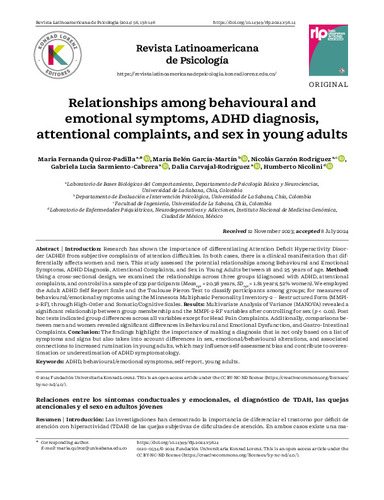
Relationships among behavioural and emotional symptoms, ADHD diagnosis, attentional complaints, and sex in young adults

Author:
García-Martín, María Belén; Quiroz Padilla, María Fernanda; Garzón Rodríguez, Nicolás; Sarmiento Cabrera, Gabriela Lucía; Carvajal Rodríguez, Dalia; [et al.]
URI:
https://hdl.handle.net/20.500.12412/7441
ISSN:
0120-0534
DOI:
10.14349/rlp.2024.v56.8
Date:
2024-07-08
Keyword(s):

ADHD, behavioural/emotional symptoms, self-report, young adults.

ADHD

Behavioural/emotional symptoms

Self-report

Young adults

Abstract:

Introduction: Research has shown the importance of differentiating Attention Deficit Hyperactivity Disorder (ADHD) from subjective complaints of attention difficulties. In both cases, there is a clinical manifestation that differentially affects women and men. This study assessed the potential relationships among Behavioural and Emotional Symptoms, ADHD Diagnosis, Attentional Complaints, and Sex in Young Adults between 18 and 25 years of age. Method: Using a cross-sectional design, we examined the relationships across three groups (diagnosed with ADHD, attentional complaints, and controls) in a sample of 232 participants (Meanage = 20.38 years, SDage = 1.81 years; 52% women). We employed the Adult ADHD Self Report Scale and the Toulouse Pieron Test to classify participants among groups; for measures of behavioural/emotional symptoms using the Minnesota Multiphasic Personality Inventory-2 – Restructured Form (MMPI2-RF), through High-Order and Somatic/Cognitive Scales. Results: Multivariate Analysis of Variance (MANOVA) revealed a significant relationship between group membership and the MMPI-2-RF variables after controlling for sex (p < 0.01). Post hoc tests indicated group differences across all variables except for Head Pain Complaints. Additionally, comparisons between men and women revealed significant differences in Behavioural and Emotional Dysfunction, and Gastro-Intestinal Complaints. Conclusion: The findings highlight the importance of making a diagnosis that is not only based on a list of symptoms and signs but also takes into account differences in sex, emotional/behavioural alterations, and associated connections to increased rumination in young adults, which may influence self-assessment bias and contribute to overestimation or underestimation of ADHD symptomatology.

Introduction: Research has shown the importance of differentiating Attention Deficit Hyperactivity Disorder (ADHD) from subjective complaints of attention difficulties. In both cases, there is a clinical manifestation that differentially affects women and men. This study assessed the potential relationships among Behavioural and Emotional Symptoms, ADHD Diagnosis, Attentional Complaints, and Sex in Young Adults between 18 and 25 years of age. Method: Using a cross-sectional design, we examined the relationships across three groups (diagnosed with ADHD, attentional complaints, and controls) in a sample of 232 participants (Meanage = 20.38 years, SDage = 1.81 years; 52% women). We employed the Adult ADHD Self Report Scale and the Toulouse Pieron Test to classify participants among groups; for measures of behavioural/emotional symptoms using the Minnesota Multiphasic Personality Inventory-2 – Restructured Form (MMPI2-RF), through High-Order and Somatic/Cognitive Scales. Results: Multivariate Analysis of Variance (MANOVA) revealed a significant relationship between group membership and the MMPI-2-RF variables after controlling for sex (p < 0.01). Post hoc tests indicated group differences across all variables except for Head Pain Complaints. Additionally, comparisons between men and women revealed significant differences in Behavioural and Emotional Dysfunction, and Gastro-Intestinal Complaints. Conclusion: The findings highlight the importance of making a diagnosis that is not only based on a list of symptoms and signs but also takes into account differences in sex, emotional/behavioural alterations, and associated connections to increased rumination in young adults, which may influence self-assessment bias and contribute to overestimation or underestimation of ADHD symptomatology.

Show full item record
Collections
  • Miscelánea
Files in this item
Thumbnail
Artículo principal (435.0Kb)
Share
Export to Mendeley
Statistics
Usage statistics
Metrics and citations  
Go to Brújula home

Universidad Loyola

Library

Contact

Facebook Loyola BibliotecaTwitter Loyola Biblioteca

The content of the Repository is protected with a Creative Commons license:

Attribution-NonCommercial-NoDerivatives 4.0 Internacional

Creative Commons Image