Brújula Home

Institutional repository of the Universidad Loyola

View Item 
  •   Brújula Home
  • PRODUCCIÓN CIENTÍFICA Y TRANSFERENCIA
  • Departamento Psicología
  • Miscelánea
  • View Item
  •   Brújula Home
  • PRODUCCIÓN CIENTÍFICA Y TRANSFERENCIA
  • Departamento Psicología
  • Miscelánea
  • View Item
    • español
    • English
JavaScript is disabled for your browser. Some features of this site may not work without it.

Browse

All of BrújulaCommunities and CollectionsAuthorsTitlesKeywordsAuthor profilesThis CollectionAuthorsTitlesKeywords

My Account

Login

Statistics

View Usage Statistics

Añadido Recientemente

Novedades
Repository
How to publish
Visibility
FAQs

Predictors of changing patterns of adherence to containment measures during the early stage of COVID-19 pandemic: an international longitudinal study

Author:
García-Martín, María Belén; Chong, Yuen Yu; Wai Tong, Chien; Cheng, Ho Yu; Lamnisos, Demetris; [et al.]
URI:
https://hdl.handle.net/20.500.12412/7442
ISSN:
1744-8603
DOI:
10.1186/s12992-023-00928-7
Date:
2023-04-17
Keyword(s):

Prosociality

Coronavirus

Adherence

Disease containment measures

Longitudinal study

Abstract:

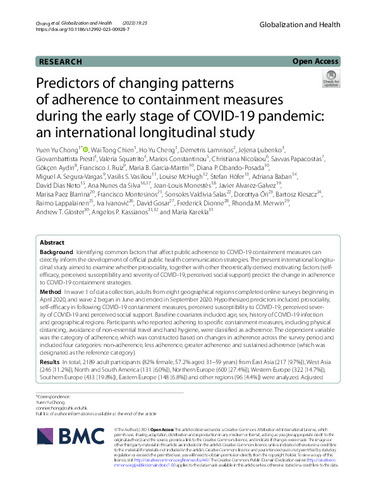
Background Identifying common factors that affect public adherence to COVID‑19 containment measures can directly inform the development of official public health communication strategies. The present international longitudinal study aimed to examine whether prosociality, together with other theoretically derived motivating factors (selfefficacy, perceived susceptibility and severity of COVID‑19, perceived social support) predict the change in adherence to COVID‑19 containment strategies. Method In wave 1 of data collection, adults from eight geographical regions completed online surveys beginning in April 2020, and wave 2 began in June and ended in September 2020. Hypothesized predictors included prosociality, self‑efficacy in following COVID‑19 containment measures, perceived susceptibility to COVID‑19, perceived severity of COVID‑19 and perceived social support. Baseline covariates included age, sex, history of COVID‑19 infection and geographical regions. Participants who reported adhering to specific containment measures, including physical distancing, avoidance of non‑essential travel and hand hygiene, were classified as adherence. The dependent variable was the category of adherence, which was constructed based on changes in adherence across the survey period and included four categories: non‑adherence, less adherence, greater adherence and sustained adherence (which was designated as the reference category). Results In total, 2189 adult participants (82% female, 57.2% aged 31–59 years) from East Asia (217 [9.7%]), West Asia (246 [11.2%]), North and South America (131 [6.0%]), Northern Europe (600 [27.4%]), Western Europe (322 [14.7%]), Southern Europe (433 [19.8%]), Eastern Europe (148 [6.8%]) and other regions (96 [4.4%]) were analyzed. Adjusted multinomial logistic regression analyses showed that prosociality, self‑efficacy, perceived susceptibility and severity of COVID‑19 were significant factors affecting adherence. Participants with greater self‑efficacy at wave 1 were less likely to become non‑adherence at wave 2 by 26% (adjusted odds ratio [aOR], 0.74; 95% CI, 0.71 to 0.77; P < .001), while those with greater prosociality at wave 1 were less likely to become less adherence at wave 2 by 23% (aOR, 0.77; 95% CI, 0.75 to 0.79; P = .04). Conclusions This study provides evidence that in addition to emphasizing the potential severity of COVID‑19 and the potential susceptibility to contact with the virus, fostering self‑efficacy in following containment strategies and prosociality appears to be a viable public health education or communication strategy to combat COVID‑19.

Background Identifying common factors that affect public adherence to COVID‑19 containment measures can directly inform the development of official public health communication strategies. The present international longitudinal study aimed to examine whether prosociality, together with other theoretically derived motivating factors (selfefficacy, perceived susceptibility and severity of COVID‑19, perceived social support) predict the change in adherence to COVID‑19 containment strategies. Method In wave 1 of data collection, adults from eight geographical regions completed online surveys beginning in April 2020, and wave 2 began in June and ended in September 2020. Hypothesized predictors included prosociality, self‑efficacy in following COVID‑19 containment measures, perceived susceptibility to COVID‑19, perceived severity of COVID‑19 and perceived social support. Baseline covariates included age, sex, history of COVID‑19 infection and geographical regions. Participants who reported adhering to specific containment measures, including physical distancing, avoidance of non‑essential travel and hand hygiene, were classified as adherence. The dependent variable was the category of adherence, which was constructed based on changes in adherence across the survey period and included four categories: non‑adherence, less adherence, greater adherence and sustained adherence (which was designated as the reference category). Results In total, 2189 adult participants (82% female, 57.2% aged 31–59 years) from East Asia (217 [9.7%]), West Asia (246 [11.2%]), North and South America (131 [6.0%]), Northern Europe (600 [27.4%]), Western Europe (322 [14.7%]), Southern Europe (433 [19.8%]), Eastern Europe (148 [6.8%]) and other regions (96 [4.4%]) were analyzed. Adjusted multinomial logistic regression analyses showed that prosociality, self‑efficacy, perceived susceptibility and severity of COVID‑19 were significant factors affecting adherence. Participants with greater self‑efficacy at wave 1 were less likely to become non‑adherence at wave 2 by 26% (adjusted odds ratio [aOR], 0.74; 95% CI, 0.71 to 0.77; P < .001), while those with greater prosociality at wave 1 were less likely to become less adherence at wave 2 by 23% (aOR, 0.77; 95% CI, 0.75 to 0.79; P = .04). Conclusions This study provides evidence that in addition to emphasizing the potential severity of COVID‑19 and the potential susceptibility to contact with the virus, fostering self‑efficacy in following containment strategies and prosociality appears to be a viable public health education or communication strategy to combat COVID‑19.

Show full item record
Collections
  • Miscelánea
Files in this item
Thumbnail
Artículo principal (909.3Kb)
Share
Export to Mendeley
Statistics
Usage statistics
Metrics and citations  
Go to Brújula home

Universidad Loyola

Library

Contact

Facebook Loyola BibliotecaTwitter Loyola Biblioteca

The content of the Repository is protected with a Creative Commons license:

Attribution-NonCommercial-NoDerivatives 4.0 Internacional

Creative Commons Image