Brújula Home

Institutional repository of the Universidad Loyola

View Item 
  •   Brújula Home
  • PRODUCCIÓN CIENTÍFICA Y TRANSFERENCIA
  • Departamento Psicología
  • Artículos
  • View Item
  •   Brújula Home
  • PRODUCCIÓN CIENTÍFICA Y TRANSFERENCIA
  • Departamento Psicología
  • Artículos
  • View Item
    • español
    • English
JavaScript is disabled for your browser. Some features of this site may not work without it.

Browse

All of BrújulaCommunities and CollectionsAuthorsTitlesKeywordsAuthor profilesThis CollectionAuthorsTitlesKeywords

My Account

Login

Statistics

View Usage Statistics

Añadido Recientemente

Novedades
Repository
How to publish
Visibility
FAQs

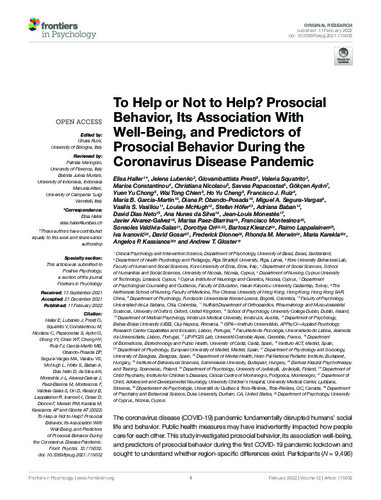
To Help or Not to Help? Prosocial Behavior, Its Association With Well-Being, and Predictors of Prosocial Behavior During the Coronavirus Disease Pandemic

Author:
García-Martín, María Belén; Haller, Elisa; Lubenko, Jelena; Presti, Giovambattista; Squatrito, Valeria; [et al.]
URI:
https://hdl.handle.net/20.500.12412/7444
ISSN:
1664-1078
DOI:
10.3389/fpsyg.2021.775032/full
Date:
2022-02-11
Keyword(s):

Prosocial behavior

Well-being

COVID-19 pandemic

Predictors of prosocial behavior

Social support

Abstract:

The coronavirus disease (COVID-19) pandemic fundamentally disrupted humans’ social life and behavior. Public health measures may have inadvertently impacted how people care for each other. This study investigated prosocial behavior, its association well-being, and predictors of prosocial behavior during the first COVID-19 pandemic lockdown and sought to understand whether region-specific differences exist. Participants (N = 9,496) from eight regions clustering multiple countries around the world responded to a cross-sectional online-survey investigating the psychological consequences of the first upsurge of lockdowns in spring 2020. Prosocial behavior was reported to occur frequently. Multiple regression analyses showed that prosocial behavior was associated with better well-being consistently across regions. With regard to predictors of prosocial behavior, high levels of perceived social support were most strongly associated with prosocial behavior, followed by high levels of perceived stress, positive affect and psychological flexibility. Sociodemographic and psychosocial predictors of prosocial behavior were similar across regions.

The coronavirus disease (COVID-19) pandemic fundamentally disrupted humans’ social life and behavior. Public health measures may have inadvertently impacted how people care for each other. This study investigated prosocial behavior, its association well-being, and predictors of prosocial behavior during the first COVID-19 pandemic lockdown and sought to understand whether region-specific differences exist. Participants (N = 9,496) from eight regions clustering multiple countries around the world responded to a cross-sectional online-survey investigating the psychological consequences of the first upsurge of lockdowns in spring 2020. Prosocial behavior was reported to occur frequently. Multiple regression analyses showed that prosocial behavior was associated with better well-being consistently across regions. With regard to predictors of prosocial behavior, high levels of perceived social support were most strongly associated with prosocial behavior, followed by high levels of perceived stress, positive affect and psychological flexibility. Sociodemographic and psychosocial predictors of prosocial behavior were similar across regions.

Show full item record
Collections
  • Artículos
Files in this item
Thumbnail
Artículo principal (830.3Kb)
Share
Export to Mendeley
Statistics
Usage statistics
Metrics and citations  
Go to Brújula home

Universidad Loyola

Library

Contact

Facebook Loyola BibliotecaTwitter Loyola Biblioteca

The content of the Repository is protected with a Creative Commons license:

Attribution-NonCommercial-NoDerivatives 4.0 Internacional

Creative Commons Image