Brújula Home

Institutional repository of the Universidad Loyola

View Item 
  •   Brújula Home
  • PRODUCCIÓN CIENTÍFICA Y TRANSFERENCIA
  • Departamento Psicología
  • Artículos
  • View Item
  •   Brújula Home
  • PRODUCCIÓN CIENTÍFICA Y TRANSFERENCIA
  • Departamento Psicología
  • Artículos
  • View Item
    • español
    • English
JavaScript is disabled for your browser. Some features of this site may not work without it.

Browse

All of BrújulaCommunities and CollectionsAuthorsTitlesKeywordsAuthor profilesThis CollectionAuthorsTitlesKeywords

My Account

Login

Statistics

View Usage Statistics

Añadido Recientemente

Novedades
Repository
How to publish
Visibility
FAQs

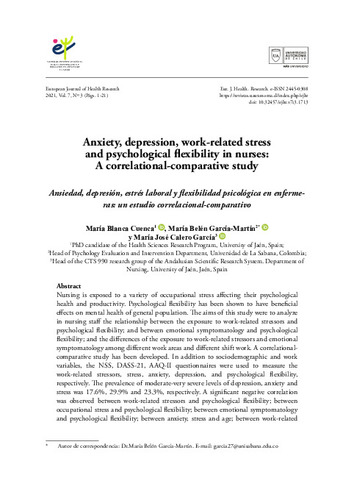
Anxiety, depression, work-related stress and psychological flexibility in nurses: A correlational-comparative study

Author:
García-Martín, María Belén; Blanca Cuenca, María; Calero García, María José
URI:
https://hdl.handle.net/20.500.12412/7447
ISSN:
2445-0308
DOI:
10.32457/ejhr.v7i3.1713
Date:
2021-03-07
Keyword(s):

Depression

Anxiety

Occupational Stress

Psychological Flexibility

Nurses

Abstract:

Nursing is exposed to a variety of occupational stress affecting their psychological health and productivity. Psychological flexibility has been shown to have beneficial effects on mental health of general population. The aims of this study were to analyze in nursing staff the relationship between the exposure to work-related stressors and psychological flexibility; and between emotional symptomatology and psychological flexibility; and the differences of the exposure to work-related stressors and emotional symptomatology among different work areas and different shift work. A correlational-comparative study has been developed. In addition to sociodemographic and work variables, the NSS, DASS-21, AAQ-II questionnaires were used to measure the work-related stressors, stress, anxiety, depression, and psychological flexibility, respectively. The prevalence of moderate-very severe levels of depression, anxiety and stress was 17.6%, 29.9% and 23.3%, respectively. A significant negative correlation was observed between work-related stressors and psychological flexibility; between occupational stress and psychological flexibility; between emotional symptomatology and psychological flexibility; between anxiety, stress and age; between work-related stressors and age. Nurses working rotating shifts reported significantly higher levels of emotional symptomatology, stress and anxiety than those working day shifts. Psychological flexibility seems to explain a significant prevalence of emotional symptomatology in nurses. Community nurses showed the lowest levels of anxiety, depression and stress when compared to hospital nurses working in different areas.

Nursing is exposed to a variety of occupational stress affecting their psychological health and productivity. Psychological flexibility has been shown to have beneficial effects on mental health of general population. The aims of this study were to analyze in nursing staff the relationship between the exposure to work-related stressors and psychological flexibility; and between emotional symptomatology and psychological flexibility; and the differences of the exposure to work-related stressors and emotional symptomatology among different work areas and different shift work. A correlational-comparative study has been developed. In addition to sociodemographic and work variables, the NSS, DASS-21, AAQ-II questionnaires were used to measure the work-related stressors, stress, anxiety, depression, and psychological flexibility, respectively. The prevalence of moderate-very severe levels of depression, anxiety and stress was 17.6%, 29.9% and 23.3%, respectively. A significant negative correlation was observed between work-related stressors and psychological flexibility; between occupational stress and psychological flexibility; between emotional symptomatology and psychological flexibility; between anxiety, stress and age; between work-related stressors and age. Nurses working rotating shifts reported significantly higher levels of emotional symptomatology, stress and anxiety than those working day shifts. Psychological flexibility seems to explain a significant prevalence of emotional symptomatology in nurses. Community nurses showed the lowest levels of anxiety, depression and stress when compared to hospital nurses working in different areas.

Show full item record
Collections
  • Artículos
Files in this item
Thumbnail
Artículo principal (310.6Kb)
Share
Export to Mendeley
Statistics
Usage statistics
Metrics and citations  
Go to Brújula home

Universidad Loyola

Library

Contact

Facebook Loyola BibliotecaTwitter Loyola Biblioteca

The content of the Repository is protected with a Creative Commons license:

Attribution-NonCommercial-NoDerivatives 4.0 Internacional

Creative Commons Image