
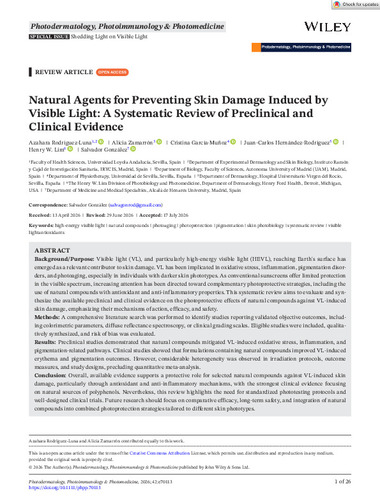
Natural Agents for Preventing Skin Damage Induced byVisible Light: A Systematic Review of Preclinical andClinical Evidence
ISSN:
0905-4383DOI:
https://doi.org/10.1111/phpp.70113Date:
2026-08-06Keyword(s):
Abstract:
Background/Purpose: Visible light (VL), and particularly high-energy visible light (HEVL), reaching Earth's surface hasemerged as a relevant contributor to skin damage. VL has been implicated in oxidative stress, inflammation, pigmentation disor-ders, and photoaging, especially in individuals with darker skin phototypes. As conventional sunscreens offer limited protectionin the visible spectrum, increasing attention has been directed toward complementary photoprotective strategies, including theuse of natural compounds with antioxidant and anti-inflammatory properties. This systematic review aims to evaluate and syn-thesize the available preclinical and clinical evidence on the photoprotective effects of natural compounds against VL-inducedskin damage, emphasizing their mechanisms of action, efficacy, and safety.Methods: A comprehensive literature search was performed to identify studies reporting validated objective outcomes, includ-ing colorimetric parameters, diffuse reflectance spectroscopy, or clinical grading scales. Eligible studies were included, qualita-tively synthesized, and risk of bias was evaluated.Results: Preclinical studies demonstrated that natural compounds mitigated VL-induced oxidative stress, inflammation, andpigmentation-related pathways. Clinical studies showed that formulations containing natural compounds improved VL-inducederythema and pigmentation outcomes. However, considerable heterogeneity was observed in irradiation protocols, outcomemeasures, and study designs, precluding quantitative meta-analysis.Conclusion: Overall, available evidence supports a protective role for selected natural compounds against VL-induced skindamage, particularly through antioxidant and anti-inflammatory mechanisms, with the strongest clinical evidence focusingon natural sources of polyphenols. Nevertheless, this review highlights the need for standardized phototesting protocols andwell-designed clinical trials. Future research should focus on comparative efficacy, long-term safety, and integration of naturalcompounds into combined photoprotection strategies tailored to different skin phototypes.
Collections
Files in this item
Share

Statistics
