
Orai1 Drives Angiogenesis after Myocardial Infarction through Notch1 Signaling Pathway
Date:
2026-05-25Abstract:
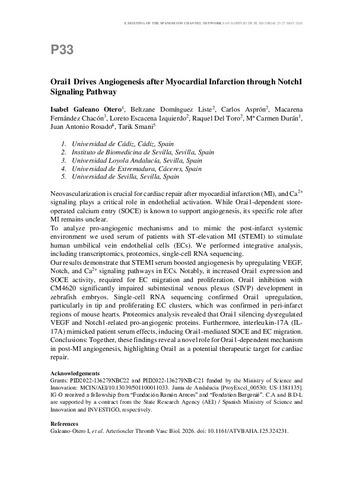
Neovascularization is crucial for cardiac repair after myocardial infarction (MI), and Ca2+ signaling plays a critical role in endothelial activation. While Orai1-dependent store operated calcium entry (SOCE) is known to support angiogenesis, its specific role after MI remains unclear. To analyze pro-angiogenic mechanisms and to mimic the post-infarct systemic environment we used serum of patients with ST-elevation MI (STEMI) to stimulate human umbilical vein endothelial cells (ECs). We performed integrative analysis, including transcriptomics, proteomics, single-cell RNA sequencing. Our results demonstrate that STEMI serum boosted angiogenesis by upregulating VEGF, Notch, and Ca2+ signaling pathways in ECs. Notably, it increased Orai1 expression and SOCE activity, required for EC migration and proliferation. Orai1 inhibition with CM4620 significantly impaired subintestinal venous plexus (SIVP) development in zebrafish embryos. Single-cell RNA sequencing confirmed Orai1 upregulation, particularly in tip and proliferating EC clusters, which was confirmed in peri-infarct regions of mouse hearts. Proteomics analysis revealed that Orai1 silencing dysregulated VEGF and Notch1-related pro-angiogenic proteins. Furthermore, interleukin-17A (IL 17A) mimicked patient serum effects, inducing Orai1-mediated SOCE and EC migration. Conclusions: Together, these findings reveal a novel role for Orai1-dependent mechanism in post-MI angiogenesis, highlighting Orai1 as a potential therapeutic target for cardiac repair.
Collections
Files in this item
Share

Statistics
