Brújula Home

Institutional repository of the Universidad Loyola

View Item 
  •   Brújula Home
  • PRODUCCIÓN CIENTÍFICA Y TRANSFERENCIA
  • Departamento de Salud
  • Artículos
  • View Item
  •   Brújula Home
  • PRODUCCIÓN CIENTÍFICA Y TRANSFERENCIA
  • Departamento de Salud
  • Artículos
  • View Item
    • español
    • English
JavaScript is disabled for your browser. Some features of this site may not work without it.

Browse

All of BrújulaCommunities and CollectionsAuthorsTitlesKeywordsAuthor profilesThis CollectionAuthorsTitlesKeywords

My Account

Login

Statistics

View Usage Statistics

Añadido Recientemente

Novedades
Repository
How to publish
Visibility
FAQs

Influence of water availability and temperature on estimates of microbial extracellular enzyme activity

Author:
Gómez, Enrique José; Delgado, José Antonio; González, Juan Miguel
URI:
https://hdl.handle.net/20.500.12412/7103
ISSN:
2167-8359
DOI:
10.7717/peerj.10994
Date:
2021-03-03
Keyword(s):

Extracellular enzyme activity

Temperature

Water availability

Water activity

Water content

Soil

Microbial activity

Abstract:

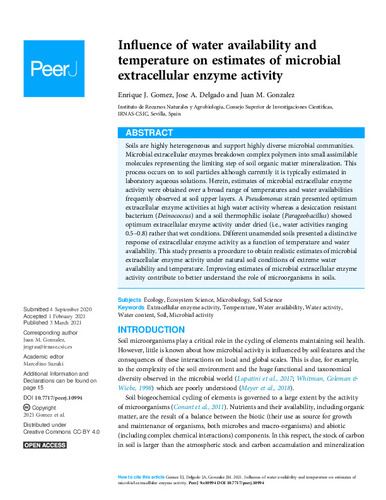
Soils are highly heterogeneous and support highly diverse microbial communities. Microbial extracellular enzymes breakdown complex polymers into small assimilable molecules representing the limiting step of soil organic matter mineralization. This process occurs on to soil particles although currently it is typically estimated in laboratory aqueous solutions. Herein, estimates of microbial extracellular enzyme activity were obtained over a broad range of temperatures and water availabilities frequently observed at soil upper layers. A Pseudomonas strain presented optimum extracellular enzyme activities at high water activity whereas a desiccation resistant bacterium (Deinococcus) and a soil thermophilic isolate (Parageobacillus) showed optimum extracellular enzyme activity under dried (i.e., water activities ranging 0.5–0.8) rather that wet conditions. Different unamended soils presented a distinctive response of extracellular enzyme activity as a function of temperature and water availability. This study presents a procedure to obtain realistic estimates of microbial extracellular enzyme activity under natural soil conditions of extreme water availability and temperature. Improving estimates of microbial extracellular enzyme activity contribute to better understand the role of microorganisms in soils.

Soils are highly heterogeneous and support highly diverse microbial communities. Microbial extracellular enzymes breakdown complex polymers into small assimilable molecules representing the limiting step of soil organic matter mineralization. This process occurs on to soil particles although currently it is typically estimated in laboratory aqueous solutions. Herein, estimates of microbial extracellular enzyme activity were obtained over a broad range of temperatures and water availabilities frequently observed at soil upper layers. A Pseudomonas strain presented optimum extracellular enzyme activities at high water activity whereas a desiccation resistant bacterium (Deinococcus) and a soil thermophilic isolate (Parageobacillus) showed optimum extracellular enzyme activity under dried (i.e., water activities ranging 0.5–0.8) rather that wet conditions. Different unamended soils presented a distinctive response of extracellular enzyme activity as a function of temperature and water availability. This study presents a procedure to obtain realistic estimates of microbial extracellular enzyme activity under natural soil conditions of extreme water availability and temperature. Improving estimates of microbial extracellular enzyme activity contribute to better understand the role of microorganisms in soils.

Show full item record
Collections
  • Artículos
Files in this item
Thumbnail
Articulo_2021.pdf (2.374Mb)
Share
Export to Mendeley
Statistics
Usage statistics
Metrics and citations  
Go to Brújula home

Universidad Loyola

Library

Contact

Facebook Loyola BibliotecaTwitter Loyola Biblioteca

The content of the Repository is protected with a Creative Commons license:

Attribution-NonCommercial-NoDerivatives 4.0 Internacional

Creative Commons Image